



























.jpg)






.jpg)
.jpg)
.jpg)


.jpg)







.jpg)




.jpg)


.jpg)





_Cropped.jpg)


.jpg)






.jpg)

.jpg)


.jpg)
.jpg)


.jpg)


.jpg)
















.jpg)










.png)




.jpg)

.jpg)
.jpg)




.jpg)
.jpg)
.jpg)
.JPG)


.jpg)

.jpg)


.jpg)





.jpg)






1.1 EVEN GOT CULLUD POLICEMANS
I’m gonna do like a Chinaman… go and get some hop Get myself a gun… and shoot myself a cop—Mamie Smith, “The Crazy Blues” (Perry Bradford, composer) Of all the wonders that Jazz Age Harlem has to offer to a wideeyed...
Established in 2013 with the launch of the Center for Art and Thought (CA+T), the Artist-in-Residence Virtual Residency is a one of a kind program that moves from the delimited physical spaces of a center or institution to the virtual spaces of the Internet. This de-centering of the physical allows the resident to work from anywhere in the world, provided that s/he has a connection to the Internet.
Over the course of his/her residency, the artist has the opportunity to work towards the completion of a project, such as a manuscript, a collection of stories, or scholarly article. The fundamental goal of the residency program is to facilitate the artist’s critical engagement with the public through his/her contributions on a virtual platform. This platform is a space for the artist to garner inspiration from an engaged audience and to work through ideas, both visually and textually.
At the end of the residency, the artist will present his or her work online. For example, s/he might present a digitally recorded podcast, a live online streamed talk, or curated online exhibition. For more information about the Artist-in-Residence Virtual Residency, please e-mail your inquiry to residency@centerforartandthought.org.
I’m gonna do like a Chinaman… go and get some hop Get myself a gun… and shoot myself a cop—Mamie Smith, “The Crazy Blues” (Perry Bradford, composer) Of all the wonders that Jazz Age Harlem has to offer to a wideeyed...
The second installment in a three-part sequence on “City of Refuge,” a 1925 short story by Rudolph Fisher. You can start here, or scroll back for earlier posts if you’d like. At the end of “City of Refuge,” the Rudolph Fisher short story I...
The conclusion to a three-part sequence on “City of Refuge,” a 1925 short story by Rudolph Fisher. For earlier posts, please scroll down. Earlier in this sequence of posts on Rudolph Fisher’s 1925 short story, “City of Refuge,” I discussed...
This is the first installment in a sequence on the geography of the lost Afro-Asian century. Scroll down for older posts, and come back for another installment next week. Back to the land of California To my sweet home...
This is the second post in a sequence on the geography of the lost Afro-Asian century. Scroll down for older posts, and come back for another installment next week. Years later, I made it back home to California. Happy birthday...
The third installment in a sequence on the geography of the lost Afro-Asian century. For earlier posts, please scroll down.The Afro-Asian century begins with a prophecy. The lost Afro-Asian century begins with a...
Part four in a continuing sequence on the geography of the lost Afro-Asian century. For earlier posts, scroll down. When you live in a falling empire, reading the news is doubly uncanny—like déjà vu, combined with the unsettling premonition...
The final installment in a sequence on the geography of the lost Afro-Asian century. Scroll down for earlier posts. I am looking for a map to everything that comes after the ending. worlds within worlds, each one lost image from...
The regularly scheduled next installment in a three-part sequence on “City of Refuge,” a 1925 short story by Rudolph Fisher, comes tomorrow. Scroll back if you missed the first one; stay tuned for more. Meanwhile, an unanticipated...
Introduction to an ongoing series published every Sunday or so.1.All investigators experience a driving urgency to uncover evidence of some sort, useful to make a particular claim. I’ve always wanted to know why, in my experience, Filipinos and...
I’m gonna do like a Chinaman… go and get some hop
Get myself a gun… and shoot myself a cop
—Mamie Smith, “The Crazy Blues”
(Perry Bradford, composer)
Of all the wonders that Jazz Age Harlem has to offer to a wide-eyed migrant from North Carolina just out of the subway at 135th Street—
“unnumbered tons of automobiles and trucks and wagons and pushcarts and streetcars”;
the promise of money, of “rights that could not be denied you” and of “privileges, protected by law”
One is “a pair of bright green stockings,” whose impossible color
—“loud green!”—
is itself enough to hold your strong man in their thrall.
More astonishing still is the existence of “cullud policemans,” attested by that “handsome brass-buttoned giant,” whose sharp whistle and outstretched, white-gloved hand
—see, there!—
carries the authority to stop vehicles loaded with white passengers in their place.
“Done died an’ woke up in Heaven,” thinks the magnificently named King Solomon Gillis, the protagonist of Rudolph Fisher’s classic New Negro Renaissance story, “City of Refuge.”
* * *
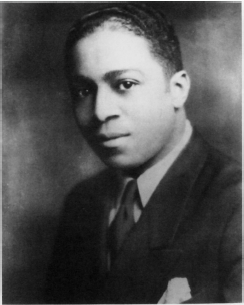
"His death was attributed to his own X-ray machines."
* * *
Your man, King Solomon Gillis—the story relishes each opportunity to repeat his full name—is of course named ironically, for he is by all evidence a fool, everyone’s and anyone’s fool, from the moment he climbs out of the subway until his confrontation by one of those “cullud policemans” at the story’s end. There is something recursive in the joke the story makes of his name, something dizzyingly ungrounded that laughter both dispels and leaves to squirm—something like making fun of Raven-Symoné for making fun of black people’s names.
Forget that for now, but know this character is yours, your own heroic fool, whose misadventures are offered up for your pleasure, entertainment, and edification in a manner that, it is implied, is inaccessible to the man himself. He is an open book that can be read by everyone in Harlem not named King Solomon Gillis.
The plot of his story is simple enough; if you’ve ever heard the skit in the middle of Stevie Wonder’s “Living for the City,” you know it already.[1] Arriving in Harlem on the run from a likely lynching in North Carolina, King Solomon Gillis is immediately marked by one Mouse Uggam, a smalltime criminal and World War I veteran who just happens to be his homeboy from back in Waxhaw, and who pretends to take him under his wing. King Solomon has only two desires—to become a policeman himself
(“so I kin police all the white folks right plumb in jail!”)
and to get a woman like the one with the green stockings. But soon enough, he’s innocently distributing Mouse’s special “French medicine” from behind the counter of his job at a grocery owned by an Italian immigrant. Before he knows it, he’s being arrested in Mouse’s boss’s cabaret by two white police detectives who’d been on the trail of their drug trade.
In the end, the story grants him this—
“the tall Negro could fight.”
Spotting the green-stockinged woman, who has somehow ended up in the same nightclub, he distractedly tosses the white men aside like soft dolls as fragmented memories of the treachery he’d fled stutter towards his consciousness:
“White—both white. Five of Mose Joplin’s horses. Poisoning
a well; A year’s crops. Green stockings—white—white—”
And then the black officer arrives.
* * *
Because the story is so elegantly made, it seems churlish to ask whether King Solomon’s apparent naïveté when confronted by the black officer is plausible. The answer is, of course, not really.
Adam Gussow concedes as much in his essay “‘Shoot Myself a Cop,’”[2] a diligent recuperation of Mamie Smith’s “Crazy Blues” (1920)—the first phonograph record by a black woman, the first blues recording by a black vocalist, and a wildfire hit among Northern and Southern black audiences, credited with establishing the market for what would be known as “race records.” Challenging a longstanding tradition among blues historians of dismissing the number as historically significant but artistically lacking—as an inauthentic novelty barely passing as the blues—Gussow takes an unusual tack, focusing on the largely overlooked couplet cited in my epigraph above. Beginning from the evidence of the record’s commercial success, he asks, “What were these black consumers thinking when they heard poor Mamie fantasize, after losing her man, of shooting a cop?”[3]
The question is not meant to be all that difficult, all caveats about generalization aside. Indeed, Gussow mentions the hapless Gillis himself, with a wink, as the exception proving the general rule of the violent communal antagonism between black people and the police arrayed against them. It was true in 1920 Harlem, where “a tiny minority” of black officers bound to protect their white brethren struggled to contain the righteous “civic fury” of its black residents.
And it was self-evident in the South, where black policemen, like other vestiges of post-Civil War Reconstruction, had long been wiped out by the same forces that made widespread public lynching effectively continuous with the operations of law enforcement.[4]
How, then, could it be possible for a figure like Gillis to be so naïve—someone whose very passage to Harlem is as a fugitive from lynch law, who relates a catalogue of white violence against any minimally successful black farmer to Mouse while simultaneously insisting that his killing of a white man was just an accident?
* * *
“Know whut dey done?
Dey killed
’fo he lef’.
five
glass
o’ Mose Joplin’s hawses
Put groun’
in de feed-trough.
Sam Cheevers
come up on three of ’em one night
pizenin’ his well.
Bleesom
out o’
he better git
to leavin’
beat
sixty
Soon
Crinshaw
acres o’ lan’
an’ a year’s crops.
’s a nigger make
a li’l sump’n
An’ ’fo long
Dass jess how ’t is.
ev’ybody’s
goin’ be lef’!”
* * *
What if King Solomon Gillis is not such a fool, after all?
To uphold this alternative is to read the story against the grain, perhaps, but in a way that is made possible by the story’s own artistry. For what makes him so persuasive and appealing, as a fool, is his utter conviction and sheer opacity: a character can only be so impossibly unknowing if he carries himself like the bearer of a secret no one knows, like an open book no one knows how to read.
In the same way, the ending of the story is more powerful by withholding the certainty of closure. Facing the black officer, Gillis is at first bewildered:
Into his mind swept his own words, like a forgotten song suddenly recalled:—
“Cullud policemans!”
The officer stood ready, awaiting his rush.
“Even—got—cullud—policemans—”
Very slowly King Solomon’s arms relaxed; very slowly he stood erect; and the grin that came over his features had something exultant about it.
This is the end; what happens next, the story will not say.
Readers have typically assumed that he has begun to surrender, his muscles relaxing in submission as his face twists in delightful anticipation of a justice that will not come. Yet because this interpretation pushes the joke of King Solomon’s foolishness from comedy to the precipice of horror—that grin, as uncanny as that on an old racist doll!—it must be left to hang.
And so this interpretation is not denied, but actually shored up by the story’s refusal to explicitly foreclose its opposite—that Gillis now fully understands the meaning of “cullud policemans,” that his body is preparing for an exercise of violence beyond anything the story has yet shown.
In other words, the ending must be structurally indeterminate because neither the likeliest interpretation nor the slim alternative would be as effective if they were actually depicted. Either way, if the story told you what happened next, it would suddenly be less plausible and satisfying.
Fool or not, Gillis’s understanding of the function of policing may be more insightful than it appears. For you or me, living through the early phases of a resurgent movement against the systematic police violence delimiting the lives of black people, the blues song’s offhand fantasy of cop-killing might seem less crazy than King Solomon’s wild enthusiasm for “cullud policemans”—but the insight they express is, in truth, the same.
When he imagines becoming an officer in order to police all the white folks right plumb in jail, he is properly apprehending and reversing the racialized and racializing logic of policing as a mode of control. (Change “white” to “black,” and you have the revenue policies for North St. Louis County.) Like the song, King Solomon denies—he does not even entertain—the illusion that the police are defined by an inclusive principle of justice, rather than by the exercise of a violence that establishes a community over against its internal enemies.
And if he fails, in his initial excitement, to appreciate the capacity of white supremacy to incorporate and assimilate nonwhite agents, his desire to seize the apparatus of state-sanctioned violence draws on a revolutionary precedent that, in 1925, is within living memory.
In a recent set of lectures, “Mike Brown’s Body,” the historian Robin Kelley notes that, as part of the continual armed struggle that was the aftermath of the Civil War, black organizers in the rural South formed militias and struggled for control over the local offices of the criminal justice system (about 46:30 in). Reconstruction’s eventual defeat may have spurred the mass migration of black Southerners to places like Harlem, but it did not change their fundamental relationship to US policing, nor did it erase the everyday knowledge that is shared as a community living in the truth of justice.
And so it is not to dismiss, but to commend King Solomon’s wisdom that you might ask, What does he know of justice? All he knows is violence.
* * *
#BlackLivesMatter, and the specificity of this slogan, rather than some false universality,[5] turns out to be, among other things, the entry point to understanding the forgotten histories of other racialized groups. The hopheaded murderous Chinaman that Mamie Smith longs to emulate is just one example, hiding in plain sight. Start looking, and you’ll find that US culture, especially prior to the Cold War, is littered with stereotypes of Asians with a predilection for antiwhite violence deemed greater and more volatile than that of black people.
But in the next installment, I’ll follow the path of King Solomon’s story to other, unexpected histories. Tracing it back a quarter-century to the Philippine-American War, and then ahead to the literature of midcentury Filipino migration, I’ll suggest that each is structured by the same relation to white American racial violence.
The question is simple: if King Solomon is not a fool, what knowledge does he bear?
The answer may be found in a song.
Welcome to the City of Refuge! New posts here every Wednesday, through the end of the year. Read with me, and tell me about it here and here.
[1] It’s been a long time, but I think I borrowed this observation from Joycelyn Moody, who was the first person to read this story with me. Either way, thanks, Joycelyn, for teaching me what it means to become a reader.
[2] Adam Gussow, “‘Shoot Myself a Cop’: Mamie Smith’s ‘Crazy Blues’ as Social Text,” Callaloo 25.1 (2002): 8-44, and reprinted in his Seems Like Murder Here: Southern Violence and the Blues Tradition, Chicago: U of Chicago Press, 2002. But if you read that, you also need to read Daphne Brooks’s take, “A New Voice of the Blues,” in Greil Marcus and Werner Sollors’s New Literary History of America, Cambridge, MA: Belknap Press, 2009: 545-50.
[3] Gussow 13.
[4] Gussow 13-15.
[5] The alternate, “All Lives Matter,” is entirely typical of the dominant concept of universality in U.S. history, which aspires to a delusion of whiteness by explicitly repudiating blackness: “all” is what you are left with when you make “black” disappear.
The second installment in a three-part sequence on “City of Refuge,” a 1925 short story by Rudolph Fisher. You can start here, or scroll back for earlier posts if you’d like.
At the end of “City of Refuge,” the Rudolph Fisher short story I began discussing in my last post, the protagonist King Solomon Gillis—a North Carolina fugitive in 1920s New York—finds himself about to be arrested by a black police officer. Momentarily dumbfounded, his mind lurches into awareness remembering the sight that amazed him when he first arrived in Harlem, days earlier.
“Cullud policemans!”
—the words appear in his mind
“like a forgotten song suddenly recalled”
—and, if any real insight is possible for this character, it emerges here.
King Solomon, as I explained earlier, is the story’s perfect fool—it’s as if everyone else in the story, along with the narrator and the reader, is in on a joke he doesn’t understand, and so it must also be possible that he gets the joke and all the rest of us are on the outside. In this post, I want to consider what kind of knowledge this figure might bear, if he isn’t such a fool after all. Here, I want to return to an essay I mentioned earlier, by the blues historian Adam Gussow, who seems to think he knows which song King Solomon is trying to remember.
Gussow’s essay, you may recall, aims to rehabilitate a historically pathbreaking but aesthetically derided bestselling 1920 record, “Crazy Blues,” written by Perry Bradford and performed by Mamie Smith. Focusing on an often overlooked couplet he calls the “emotional crescendo” of the last verse—
I’m gonna do like a Chinaman… go and get some hop
Get myself a gun… and shoot myself a cop[1]
—Gussow glimpses the brief resurfacing of a long tradition of “badmen” (and sometimes badwomen) across black folklore, music, and literature. In particular, Gussow is eager to suggest that Perry Bradford had one particular badman in mind—the legendary Robert Charles.
A Mississippi native who’d escaped lynch-ridden Copiah County for New Orleans a few years earlier, Charles was unjustly accosted by three policemen on a neighbor’s doorstep on July 23, 1900. After Charles and an officer exchanged gunshots, he fled, and when the police caught up with him later that night, he killed two before escaping. Extensive white rioting over the next few days claimed three black lives and injured dozens more. But before Charles was finally killed, the building he was hiding in set aflame, he managed singlehandedly to shoot over two dozen whites, killing seven, including five members of the mob that came to lynch him.
Gussow’s interest in this particular badman stems from his subsequent appearance in a noted episode in blues history, in which the famed New Orleans musician Jelly Roll Morton told the folklorist Alan Lomax about Charles’s legend, but refused to sing the song that was supposed to have circulated about it. By insisting he’d forgotten the song in order to keep out of trouble, Morton ensured that several generations of blues collectors would obsess about recovering the tune. Marshalling what he admits is circumstantial evidence, Gussow does his best to suggest that the reference to cop-killing in “Crazy Blues” was explicitly composed as its echo.
But other reverberations are also possible. Charles, it is reported, was a follower of Bishop Henry McNeal Turner, the prominent African Methodist Episcopal churchman best known today for promoting black emigration to Liberia, who advocated for armed black self-defense. It is also said that Charles was radicalized by the infamous 1899 lynching of Sam Hose in Georgia, a case most thoroughly documented by the great anti-lynching crusader Ida B. Wells-Barnett—another proponent of armed self-defense—who would subsequently publish a record of Charles’s own death. W.E.B. Du Bois himself would later report that it was Hose’s murder, and his own near-encounter with a butcher shop display of Hose’s severed knuckles, that redirected his path from an idealistic social scientist to a committed political activist, guided by “a red ray which could not be ignored.”
This red ray reached as far as the Philippines, via Hong Kong, where exiled leaders maintained global networks for the nationalist side in the ongoing Philippine-American war. Hence, on their first movement outside Manila, African American soldiers of the segregated 24th Infantry discovered propaganda placards left in their path, which announced,
“the blood of your brothers Sam Heose [sic]
and Gray proclaim
vengeance.”[2]
Opposition to the Philippine American war, shared by Du Bois and Wells, was typical of black public opinion at the time, although a line was usually drawn at criticism of black soldiers, who were instead praised as models of the civilized and civilizing capacity of the race.
But Bishop Turner danced on that line:
“I boil over with disgust when I remember that colored men
from this country that I am personally acquainted with are there
fighting to subjugate a people of their own color and bring them
to such a degraded state.
I can scarcely keep from saying that
I hope the Filipinos will
wipe such soldiers
from the face of the earth.”
Indeed, a handful of black soldiers chose to desert and switch sides. The best known was a teenaged corporal of the aforementioned 24th Infantry from Tampa, David Fagen, whose exploits as an officer in Emilio Aguinaldo’s forces became legend. Promoted to captain under Gen. José Alejandrino, and referred to as a general in the U.S. press, he persisted in guerilla warfare even after Aguinaldo and Alejandrino surrendered. The bedeviled US Gen. Frederick Funston’s frustrated desire to lynch him was so well known that his own sister-in-law mocked it at a Christmas dinner, conjuring a vision of Fagen’s hanged body in a playful bit of light verse:
By Jiminy Christmas Fred
What’s this I see?
Poor old Fagen
Hanged to a tree?
How did it happen
This is queer
Tell us about it
We’re dying to hear.
Fagen was supposedly killed in December 1901 by a Filipino hunter named Anastacio Bartolomé, who delivered his severed, decaying head to U.S. forces, along with a few personal effects. But there is good reason to believe this grisly evidence was not entirely credited by the authorities, and regardless, Fagen’s story continued and continues to circulate.
Who was David Fagen, really? Where did he come from, and what happened to him? After decades on his trail, the military historian Frank Schubert finally concluded that the most apt way to understand Fagen’s identity was to recognize him as a figure of legend—the badman.[3]
* * *


text: LA Times, 16 August 1901
photo: LA Times, 17 August 1901
* * *
It was impossible to capture David Fagen, because he had already escaped into myth.
This myth has been rediscovered, decade after decade, among all those captivated by militant resistance to the racist violence of U.S. empire, on both sides of the Pacific, war after war after war. What history drags back from myth, every time, is always as decomposed and dubious and uncanny as that sack of moldering remains
—(oh!)—
hauled back from the field to be presented to the gathering audience.
David Fagen is not here, not any more than Sam Hose or Robert Charles or King Solomon himself. For that, you and I should give a cheer, even if it is uncertain what point of identification you or I might take in rehearsing this story—the suspicious Bartolomé, the distrusting white colonial authorities, or some cold-eyed darker observer keeping her own counsel at the margins of the scene.
Before you can ask what message Fagen brings, you must ask how he could be made to speak. What is left of his story is, after all, only a token, like the head in the sack, the knuckles in the window, or the blood of your brothers that both speaks and acts at once, beyond death, proclaiming vengeance.
Whose voice is this? Aren’t these really someone else’s words, poorly disguised, setting themselves up within violence’s gruesome trophy to promote their own interests? Or is it possible that an agency exists within the inanimate or murdered object, that the dead can find expression through the bodies of the living, their tongues and mouths and fingers? Doesn’t every act of ventriloquism raise the specter of possession?
Welcome to the City of Refuge! Coming up in the conclusion to this sequence: jokes, lies, and the secret identity of a bicycle thief. New posts every Wednesday, through the end of the year. Read with me, and tell me about it—a comment section should appear below if you’re signed in to Facebook, but you can always reach me here and here.
[1] Gussow 10.
[2] The most detailed account of this well-known propaganda is in Cynthia Marasigan’s 2010 dissertation from the University of Michigan, “‘Between the Devil and the Deep Sea’: Ambivalence, Violence, and African American Soldiers in the Philippine-American War and Its Aftermath,” pp. 62-67. “Gray” is presumably Edward Gray, lynched in Louisiana that June.
[3] See most recently his “Seeking David Fagen” in Tampa Bay History 22 (2008): 19-34, which includes all the information above. Schubert prefers to use the historically correct epithet, “bad nigger” (34).
The conclusion to a three-part sequence on “City of Refuge,” a 1925 short story by Rudolph Fisher. For earlier posts, please scroll down.
Earlier in this sequence of posts on Rudolph Fisher’s 1925 short story, “City of Refuge,” I discussed the blues historian Adam Gussow’s reference to a famous interview by Alan Lomax, in which the musician Jelly Roll Morton refuses to sing a lost song about Robert Charles, a legendary New Orleans fugitive.
The literary scholar Bryan Wagner has also written about this episode, comparing it with another famous anecdote told by Morton’s rival, W.C. Handy, the self-proclaimed “Father of the Blues”—a music he claims to have first learned from a “lean, loose-jointed Negro” casually singing and playing the guitar on the platform of a Mississippi train station.[1]
Wagner identifies this figure—the “ragged songster”—not as a real person, or even a specific invention of Handy’s, but as the necessary convention of a narrative. He is imagined by folklorists and blues collectors as the authentic source of the music because he is nameless and homeless, a cipher without any particular history or consciousness of his own worth knowing. He is indistinguishable from his song, because he sings what he does and does what he sings.
But Wagner’s most provocative insight is to connect this figure to its counterpart in the legal history of policing, which, he insists, is inextricable from the history of blackness more broadly. The police power, he argues, can be distinguished from the other ways institutions of law operate to produce what gets called justice. This power resists restrictive definition, and is accorded wide discretion, because it is understood to protect and defend the community against threats by deploying violence as deemed necessary, even preemptively.
For Wagner, the figure of black vagrancy featured in Handy’s anecdote, which is foundational to an entire array of histories of blues music and black culture, ought to be understood as a kind of formal convention given by the history of U.S. policing. It traces back to the regimes of slavery, when any white person was invested with the police power in relation to all black people. It is consolidated against the Jim Crow era’s black vagrant—that is, anyone the police chose to criminalize as inherently out-of-place and threatening, thereby subject to violence.
And it explains, among other things, why in 2015 it is so difficult to challenge the legitimacy of violence committed against black persons, by a policeman of any color, within the justice system.
From this perspective, withholding the Robert Charles song interrupts a procedure that is overdue for questioning. Independently of the race, intentions, good faith, or moral character of the blues collector, the protocols inscribed in his understanding of folk culture have their own effects. They obscure the work of the system that transforms violence into justice, celebrating a culture by removing its “treasures” from the very situations, social and historical and political, they name and engage and act upon.
You must ask, then, if the attempt to recover a lost song is merely another incursion into the everyday imaginative practices of the people whose can most clearly see and name this justice for the violence it is. How can the work of a scholar—whose own color, like the policeman’s, is at best a secondary matter—be other than plunder? Is it possible to respect the opacity of a figure like Robert Charles or David Fagen—to refrain from compelling it to sing—without overwriting its potential to act upon anyone within earshot, as the vehicle of a haunting by that which it works to keep concealed?
* * *
* * *
For the great scholar Alain Locke, whose intellectual P.R. efforts were central in defining what would become known as the Harlem Renaissance, the knowledge carried by a figure like King Solomon Gillis was epochal. The “migrating peasant [….] the ‘man farthest down,’” rushing to the industrial cities of the North and Midwest in droves, was reshaping the destiny of both the U.S. and the “Negro” race worldwide.
But in Locke’s view, the “great masses” were hardly “articulate as yet.” While the doctors, lawyers, and ministers of their Southern communities trailed meekly behind them, a different elite could give their thoughts expression—the college-trained intellectuals and young artists, like Rudolph Fisher, that Prof. Locke sought to mentor.
King Solomon Gillis, in other words, is an intellectual construct, a way to imagine someone in order to grant someone else the authority to narrate their consciousness. This imaginative work is a form of violence, which needs to be called out, even if I must admit—as an admirer of Locke and sometime practitioner of his profession—that it often requires great effort to keep from participating in it.
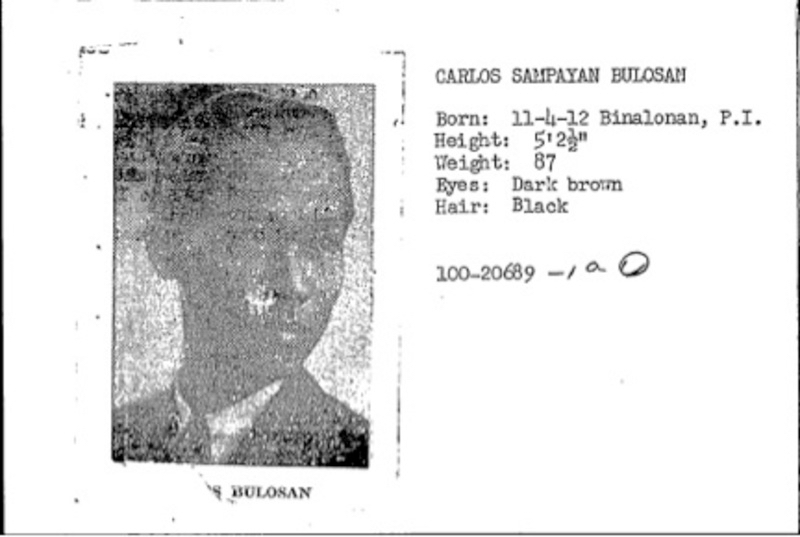
And this construct was not without its uses. The best-known writers to emerge from Locke’s milieu, Langston Hughes and Zora Neale Hurston, sometimes occupied it and put it to use, even as their very existence undermined its presumptions. Similarly, the two best-known writers emerging from the colonial migrations of Filipinos to the U.S. accelerating in this period, Carlos Bulosan and José Garcia Villa, occasionally took refuge in the primitive, making the best of the only role metropolitan intellectuals offered them.[2]
In short, the migrating peasant or the primitive, like the vagrant, the ragged songster, and the badman, is among other things, a mask. In a famous essay, Ralph Ellison observed, “the Negro’s masking is motivated not so much by fear as by a profound rejection of the image created to usurp his identity. Sometimes it is for the sheer joy of the joke; sometimes to challenge those who presume, across the psychological distance created by race manners, to know his identity.”
Ellison, himself concerned to avoid the snare of folk authenticity he saw closing on himself and his celebrated novel, Invisible Man, sharply noted that this masking was “in the American grain,” citing such practitioners as Benjamin Franklin, Ernest Hemingway, William Faulkner, and Abraham Lincoln—not to mention Bulosan, Villa, and Phil Hartman. “America is a land of masking jokers,” he wrote.
But who gets to be in on the joke?
* * *
In the summer of 1901, a young black man calling himself Rube Thompson, outfitted in a blue, brass-buttoned coat, infantry hat, and long-topped shoes, was arrested in Pasadena, California on suspicion of stealing a bicycle. Variously reported as 20, 18, and 22 years old, he claimed to be on his way back home to Texas after two years in Manila, and his brash attitude and gift for fabulism initially dazzled the white judges, lawyers, and journalists he encountered in the sleepier reaches of the Los Angeles legal system.[3]
In his first appearance in the LA Times on Aug. 4th, a Justice Morgan is reported to be left “spellbound” and speechless by Thompson’s insouciant management of his own defense. Four days later, he appears pleading guilty before a different judge, who becomes suspicious of police misconduct and forces Thompson to confess, picking shyly at his “tattered soldier’s suit,”
“I’se a-pleadin’ guilty ’caz I haint got no witnesses an’ no lawyer.”
One is quickly appointed for him, and another attorney who happens to be present volunteers to assist in the case, leaving the police detective fuming.
But the story takes a more dramatic turn on Aug. 16th, when Thompson makes the remarkable assertion that he is actually none other than the notorious deserter and rebel, “John Fagens.” Though he got most of the names wrong, his confession demonstrated a detailed awareness of David Fagen’s publicly reported exploits, and an expectation, perhaps slightly exaggerated, that the local authorities would know of them as well.
Within a day, Fagens’s story fell apart, though it had already made its way into the San Francisco Chronicle, and was still working its way through newspapers in Hawai’i ten days later. The Times presumed he was scheming to get transferred beyond the reach of the local courts, whereupon the exposure of his identity might lead to his release. The historian Timothy Russell, who uncovered his story, has verified that a “Reuben Thompson” was employed as a teamster by the U.S. Army Quartermaster in Manila from November 1899 to April 1900. Of course, this identity could have been appropriated, too; in any case, the alleged bicycle thief is last glimpsed in the record on his way to a two-year sentence in San Quentin.
Frank Schubert has turned up a related, if clearly apocryphal, story about David Fagen’s father, who died after his seventh son came home from a tour with the 24th Infantry in Cuba, but prior to his reenlistment and departure for the Philippines. In a 1959 volume of Florida history, Sam “Fagin” is falsely depicted as “a shiftless old Negro who was never known to work, but had about 20 children.”
Hauled to court on a charge of chicken-stealing, he’s so unnerved by the stern judge that he confesses, but his white lawyer quickly intervenes to enter a plea of not guilty. In response, the judge, citing his proud South Carolina heritage, immediately dismisses the case: for how can he take the word of a black man over a white man?[4]
It is not so strange, I suppose, that the myth of David Fagen would draw stories like these in its wake, as if magnetized by their shared themes of racial masquerade, deception, and escape. But is it an accident that the most definitive imagination of a successful getaway appears in the story that, beyond the flimsiest pretense of historical details, is so clearly just a retelling of an old racist joke?
* * *
You:
“invisible things are not necessarily ‘not-there’”
The Library:
Just because you can’t see it doesn’t mean it isn’t.
You:
“nothing that has ever happened should be regarded as lost for history”
The Library:
Sometimes being lost is the condition of refuge.
You close your eyes and push on the wall
it moves
and the music!
* * *
In his dazzling book of criticism, The Grey Album, the poet Kevin Young identifies three types of “shadow books” that haunt black literature.
The first,
promised or proposed or begun and abandoned,
is the unwritten.
The second,
described or alluded to or even
quoted in an existing text, but teasingly
withheld, so that
so that its actual nonexistence becomes
a way of making meaning, resonating
with the blindspots and erasures
of knowledge and perception that
for better or worse
race establishes,
is the removed.
And the third,
the most straightforward and bedeviling,
is the lost
—once written, but no longer extant.[5]
It would be difficult to find a more prolific author of shadow books than Carlos Bulosan, whose published and unpublished writings abound with references to works in all three categories—sometimes, paradoxically, all three at once. The Rosetta stone of his shadow oeuvre is an April 8, 1955 letter he wrote to Florentino B. Valeros, located in his papers at the University of Washington Libraries and published as an appendix to All the Conspirators—which was itself once one of his shadow books, recovered in his papers bearing the byline “Dunstan Peyton” and published three decades after his death.
Bulosan opens the letter by explaining he’s just arrived in the union office (ILWU Local 37, Cannery Workers) from jail, adding ambiguously:
“When a person just came out of jail (drinking?)
his mind wanders in a nightmare
that pursued him the night before.
Now a long time ago I made a resolution never
to reveal certain facts of my personal life;
I resolved also not to give to anyone
a complete bibliography of my published writings.”
But he allows that he’ll make an exception for Valeros’s wife Margarita, who is preparing a thesis on his work.
He then unleashes a brilliant, rambling, sometimes vague and incomplete, and occasionally demonstrably false accounting of his bibliography. He refers to poems and stories and books he has lost, forgotten, planned, and failed to write, as well as two books for young readers that, if they exist, were likely written by someone else.
Eventually, the text drifts off in a digression about how much alcohol he claims to be capable of drinking, breaking in mid-sentence at the end of the page. It picks up again, perhaps a day later, in a more ordered list that finally teeters and trails off the page:

This letter, which I’d argue should be read as a statement of Bulosan’s rigorous commitment to an aesthetics of labor migrancy, is worth at least a full post on its own. But in closing this one, I want to turn from his shadow books to the one book by Bulosan that readers are likely to know, his 1946 “personal history,” America Is in the Heart.
In one of its most famous lines, the narrator describes how, as a migrant in the 1930s metropole, he came to understand:
“it was a crime to be Filipino in California.”
The occasion for this insight is his experience of police harassment for Driving While Filipino—
“the public streets were not free to my people:
we were stopped each time
these vigilant patrolmen saw us driving a car.”
Or, as his companion Doro explains,
“They think every Filipino is a pimp[….]
I will kill one of these bastards someday!”
Because anti-Filipino racism in the U.S. no longer takes quite the same form it did before World War II, it is easy to overlook its relationship to antiblack racism in this period. What they share is the structure of an overwhelming, sexualized violence, manifested in lynching and colonial warfare.
Those placards proclaiming vengeance for Sam Hose, left for black soldiers outside Manila, aimed to make this link visible, and it is this link that is presumed every time the story of David Fagen is invoked. The vengeance Doro imagines, perhaps, is something like the fate of Robert Charles, as narrated by Ida B. Wells-Barnett:
“Betrayed into the hands of the police, Charles, who had already sent
two of his would-be murderers
to their death, made a last stand in a small building,
1210 Saratoga Street,
and, still defying his pursuers, fought
a mob of twenty thousand people,
single-handed and alone, killing
three more men,
mortally wounding
two more
and seriously wounding
nine others.
Unable to get to him in his stronghold, the besiegers set fire to
While the building was burning Charles was shooting,
and every crack of his death-dealing rifle added another victim to
the price
which he had placed upon
his own life.
Finally, when fire and smoke became too much
for flesh and blood to stand, the long sought for
fugitive appeared in the door, rifle in hand,
to charge
the countless guns
that were drawn upon him. With a courage which was
indescribable,
he raised his gun to fire again, but this time it failed, for
a hundred shots riddled
his body,
and he fell
dead
face fronting
to
the mob.”
* * *
What is the difference between security and refuge?
In the history of the blues, as written by its devoted collectors, the song of Robert Charles ranks in the canon of shadow books. But the great and tragic joke of the quest to recover it is that the song of Robert Charles is not so much lost as ever-present.
It’s anywhere you want to look or listen, in the history of black music from 1900 to the present, and as you read this, it is being recomposed and rearranged, recorded and uploaded, in Florida and Missouri and Ohio, in South Carolina and New York and California, in Minneapolis and Chicago and everywhere else. (When the fire starts, who’s to say where it will stop?) If you cannot hear it yet, you may at least lift your head and give a nod to our visitors from the future, trawling in the digital archives, those historians of whatever it is that comes after hip-hop.
Don’t credit too much what I am about to say next, for I am too poor a reader sometimes. But I have never quite been able to catch the feeling for utopia, which has always sounded to me like the gated community of the radical imagination.
I prefer to dream of a vast electronic library of shadow books. Would you lose yourself in its stacks? Even there, the dissertations gather dust: they are ballast, or they are kindling. (That must a fourth category—the books that have been written that no one ever bothers to read.)
In my mind, I close the cover, and lay one more title onto the pile:
Robert Charles’s City of Refuge, Carlos Bulosan’s Crazy Blues.
Would you bring an ark, or a match?

Chicago, c. 1950
Vincent T. Tajiri Estate
Welcome to the City of Refuge! Coming next week, a new sequence on the lost Afro-Asian century, featuring W.E.B. Du Bois, Philippine-Ethiopian intrigues, and the transpacific antecedents of Afrofuturism.
New posts appear here every Wednesday, through the end of the year. Read with me, and tell me about it—a comment section should appear below if you’re signed in to Facebook, but you can always reach me here and here.
[1] Even in myth, the shadow of empire: Handy associates the man’s technique of pressing a knife on the guitar strings to “a manner popularized by Hawaiian guitarists,” as quoted on p. 26 of Wagner’s Disturbing the Peace: Black Culture and the Police Power after Slavery, Cambridge, MA: Harvard UP, 2009. Chapter one deals with Handy, Morton, and Charles.
[2] I’ll have more to say about this in a later post. But get the conversation started, if you’re inspired!
[3] See Timothy Russell’s 2013 dissertation from the University of California, Riverside, “African Americans and the Spanish-American War and Philippine Insurrection: Military Participation, Recognition, and Memory, 1898-1904.” Coverage of the case can be found in the LA Times of August 4, 8, 16, and 17, 1901, and the August 16 LA Herald, as well as less substantive coverage in the August 16 San Francisco Chronicle, August 26 Pacific Commercial Advertiser (Honolulu), and the August 27 Hawaiian Gazette.
[4] See Schubert 21; he notes that Sam Fagen bore little resemblance to this figure, and that the same anecdote can be found elsewhere with different characters.
[5] See Young, The Grey Album: On the Blackness of Blackness, Minneapolis: Greywolf, 2012, pp. 11-14. The book’s comments on Mamie Smith’s “Crazy Blues” (esp. 159-65) are very much worth discussing, but I’ll hold off for now.
This is the first installment in a sequence on the geography of the lost Afro-Asian century. Scroll down for older posts, and come back for another installment next week.
Back to the land of California
To my sweet home, Chicago
—Robert Johnson
Chicago, my hometown, I miss you dearly. But goddamn you are racist and corrupt as hell.[1]
The man who’s supposed to run you owes his seat to the cover-up of a murder, the arbitrary and gratuitous execution of a boy, and now the whole world knows. The sport of it, now, Chicago, is to watch the fix as it plays out in plain view, in slow motion, to watch and see who gets sacrificed to preserve whose power, and how quickly the breach can be closed, if there even is one, in the brutal business of the city.
But even if he falls, Chicago, he is only the expression of your own vicious heart. What god could be blamed for visiting you now with fire?
Chicago, did you ever want to be free?
* * *
Once upon a time, Chicago, you were the city of refuge, for my grandparents, and for a whole generation of Japanese Americans looking for a way out of the camps where they’d been locked up by their own government. You were no kinder then, just younger and more wide open, and there was a war on and so much of a world for the taking.
The well-intentioned liberals who ran the wartime incarceration regime and its offshoots promised that it was the very best of the Nisei they were sending you, American-born children of Japanese immigrants who worked hard and loved baseball and swing music and everything else you said you did, and you could count on them to be first in line to die for it.
To be honest, they didn’t really want the Nisei to get bunched up in one place like they did. They’d chosen the best specimens to send out in an advance guard from the camps, and encouraged them to spread out in twos and threes across the heartland. If these Japanese just learned not to throng together like they did in their old colonies along the West Coast, they reasoned, they’d dissolve into Middle America like sugar in a white girl’s mouth.
But this wasn’t the sort of idea that survived a few days in the sun, and so the Nisei “resettlers” mostly found their way to you, Chicago, and, then as now, you were willing to tolerate the fine visions of liberal do-gooders as long as they didn’t require you to pay much notice. So my grandfather, a soldier, and my grandmother, a Poston beautician with a degree from the San Francisco School of Beauty Culture, slipped into your shadowy assembly.
Chicago, did you ever want to be free?
* * *
When they got to Chicago, my grandfather didn't work for a year. Instead, he went to the beach every day, my aunt says he told her, thinking about what he was going to be. He got a job as a civil servant, then backed out at the last minute. He took a class in photography, but he knew more than the teacher.
You're a photographer, Chicago told him, won't you admit it? What else could he be, when the city winked at him like this?
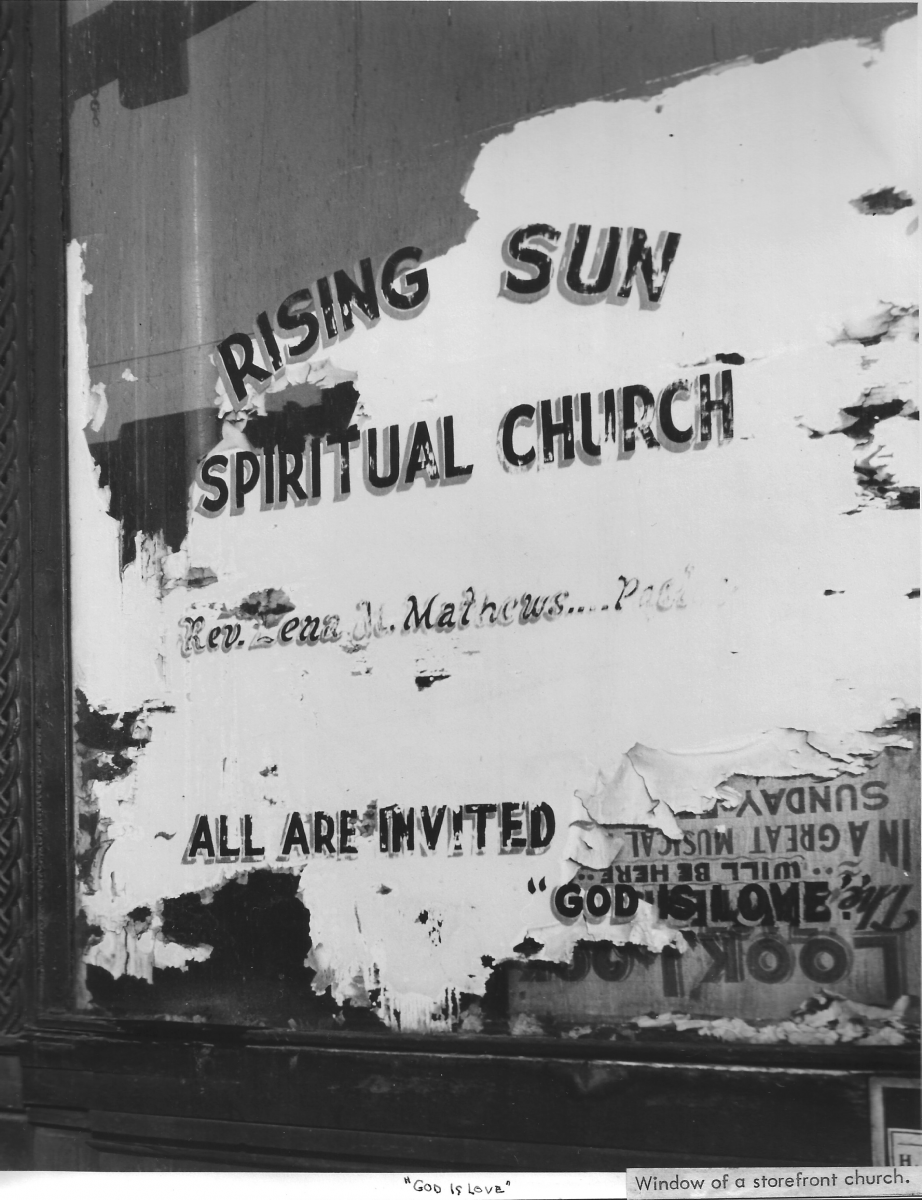
Photo credit: Vincent T. Tajiri Estate
Reader, if you know anything about
this image, please let me know.
I assume that this reference to the rising sun had nothing to do with Japan. But I would not be surprised if my grandfather was aware of the deep current of pro-Japanese sentiment that ran through prewar African American communities.
Stemming at least as far back as the 1904-05 Russo-Japanese War, it found adherents in all regions and strata of black society, though by the mid-1930s it seems to have been strongest in working-class milieus, blending politics and religion, running a circuit from the Great Lakes down to the Mississippi Delta.
It was suppressed, of course, during the war, through the extensive and coordinated activities of federal and state officials from Chicago to East St. Louis and New Orleans, and from Kansas City to D.C., Harlem and Newark. Mortified, the black elite did its part to put down and stamp out these seditious sympathies.
Among other things, their concerted effort helped an up-and-coming young college teacher named S.I. Hayakawa land a column at the Chicago Defender. There, he reassured readers of the leading black newspaper that the Nisei were loyal Americans, and that well-meaning white Americans would do more for them than “the whole Ethiopian army or Japanese navy.”[2]
In time, I will have more to tell you about Hayakawa and my grandfather, about black sympathies for imperial Japan, and why the specter of an Ethiopian army keeps leading me back to the Philippines. For now, I just want to pause over this image. It must have given him a smile.
What would he have been thinking, behind that smile?
Without question, my grandfather would have found himself on the side of all those African Americans and Japanese Americans eager to bury any hint of pro-Japanese sentiment. Indeed, those were the terms on which Negro-Nisei civil rights coalitions would, for at least a few years, be built.
Raised on a predominantly African American block in multiracial south central L.A., he must have felt some degree of familiarity within Chicago’s communities of black Southern migrants. Not out of some special affinity for black folks—despite the prescriptions of the liberal theorists of assimilation, the urban segregation he’d always known still tended to herd nonwhite communities together. And he’d come to Chicago from Mississippi himself, having done most of his military service at Camp Shelby since his health precluded him from combat overseas.
And he was decidedly not religious, despite having acquired a Catholic “American” name. Why, then, did he emphasize the phrase, “God is love”? Was this another joke, or an appreciation? Or just a way of deflecting attention from the joke of the church’s name?
“Look Look,” calls the sign, upside-down, behind glass, in the corner. What is it calling you to see?
* * *
Of the boy who was killed, a ward of the state: he should not be denied his name. It is wrong not to say his name, and it is wrong again to say it. Every repetition of his name bears forward the work of his killers, that violence through which you and I are called upon to perceive and make sense of the world, and if there is another world where calling his name might bring him justice, may you live long enough to see it.
If there is any justice to be found, in this world, it will come for everybody else, in his absence, because this is what it means to ask for justice in the name of the dead. Of course, what is true for the dead is merely the end of an illusion maintained by the living—that your name is your very own, when instead, like your very identity, it belongs to everyone else but you. This is why I keep hesitating every time I start typing his name. To write it would only repeat the way that his life been given away to everyone but himself.
It is wrong to say his name, and it is wrong again not to say it. This is the case, simply put, because it is the world you and I are in that is wrong, the world where he is not, and no one has figured out yet how to put it right. To act at all in this world is to be in the wrong, but one must still act; and so I choose not to write his name, and instead ask you to speak it, aloud, in silence.
* * *
On Sunday, there will be music—this much you can still make out. “Look Look,” it says behind the glass.
* * *
Chicago, capital of the lost Afro-Asian century, on what map could I find you?
(Will I have to listen to that song again? What kind of Chicagoan isn’t tired of that song?)
Bear with me, reader. This is an essay on the geography of that lost century, but it is also a personal history, and for me, everything will keep on ending in Chicago.
It will begin in the Philippines, or it will begin in Georgia. It will begin, as you might expect, in an act of overwhelming violence. And it will go wherever the music will take you.
Meet me here next week?
* * *
Welcome to the City of Refuge! Coming up in this sequence: further explorations of blues music, secret identities, bitter jokes, and geopolitical intrigue, with appearances by Robert Johnson, W.E.B. Du Bois, Emilio Aguinaldo, and Emperor Menelik II of Ethiopia.
New posts every Wednesday, through the end of the year. Read with me, and tell me about it—a comment section should appear below if you’re signed in to Facebook, but you can always reach me here and here.
[1] I won’t link to the video here. If you can watch it without being traumatized or indifferent, you should; it’s no trouble to find. But this is for everybody.
[2] S.I. Hayakawa, “Second Thoughts.” Chicago Defender 16 June 1945: 17.
This is the second post in a sequence on the geography of the lost Afro-Asian century. Scroll down for older posts, and come back for another installment next week.
Years later, I made it back home to California.

Happy birthday, Shinkichi Tajiri!
* * *
When, as a young man, I went off to school in a cold, grey Midwestern town, blues music became the vehicle of my homesickness. Chicago blues I liked well enough, but it was other sounds that carried me—Lightnin’ Hopkins, John Lee Hooker, the late recordings of Son House. Music of displacement, of people who made their own maps.
Well. I’m old enough now to know that, really, nobody wants to hear about the music you liked in college. And if I’m being honest, Robert Johnson was never quite my favorite. But his version of “Sweet Home Chicago” haunted me for years.
Long before it became a blues standard—if not a grating cliché—Johnson recorded the song in a San Antonio hotel room in 1936. A Delta-based itinerant musician whose travels took him as far as New York, Canada, and Chicago, Johnson’s dazzling technical abilities and early death have made him, for better or worse, a figure of legend.
In his version, sweet home is not an origin, but a destination: the singer seductively invites his listener to leave the place they are in, and come with him to the more glamorous locales he proclaims his own. Don’t you want to go, he asks,
Back to the land of California, to my sweet home Chicago.
Long after his death, this line would cause untold vexation for many of Johnson’s most fervent devotees, who have gone to great lengths to banish the thought that he might have been so ignorant of basic geography as to place Chicago in California.[1]
Of course, he wasn’t. The problem isn’t necessarily that blues historians condescend to the people who made the music they love, though they too often have. Rather, as I discussed in an earlier post, the very concept of authenticity through which the blues has been defined as a distinct cultural tradition tends to imagine a songster unencumbered by modern knowledge.
For the same reason, discussions of Robert Johnson conventionally require some reference, leg-pulling or dismissive, to the old myth that he acquired his talent for guitar by selling his soul to the Devil at a crossroads one midnight. It’s easier to wrestle down this old hackneyed story, it seems, then to face the reality that the bluesman shared a world with you, that his craft required intelligence, that he earned his skill with diligence. It’s easier to spend a lifetime chasing his shadow than to recognize that the distance, from there to here, can be bridged in a simple instance of parataxis.
* * *
But to me, the song was always a map. In its geography of yearning, I would eventually discover my own family’s history.
For poor African Americans in the Mississippi Delta in the 1930s, California and Chicago were places of refuge, homelands of the future where the migrants streamed in flight from poverty, arbitrary imprisonment, and state violence and its counterpart in lynch law. World War II brought a new phase of this Great Migration, swelling the seams of black Chicago and bursting them in Los Angeles, where the segregated areas vacated by incarcerated Japanese Americans became overcrowded with new arrivals from the South.
As the war progressed, the liberal stewards of the incarceration regime sought to empty the camps and engineer the redemption-by-assimilation of loyal Japanese Americans, dispersing them across the country, as far from their old West Coast ghettoes as possible. In Chicago, the arrival of “resettlers,” like my grandfather and his family, was meant to be carefully distinguished from the “race problem” presented by the ongoing black migration.[2]
Meanwhile, back in L.A., “Little Tokyo” was being rebranded as “Bronzeville.” But to skeptics like the great novelist Chester Himes, this bit of boosterism could not erase the fact that black migrants had merely taken up residence in a “race problem” previously mapped as Japanese. Himes was a recent arrival himself, a faculty brat from Missouri and the Arkansas delta who’d survived a fall down a Cleveland elevator shaft and terms in Ohio State University and the Ohio State Penitentiary. In L.A., he rented the home of the Nisei writer Mary Oyama Mittwer, who became a close friend.
A few months after I was born, my grandparents moved back to California, leaving us behind in the crumbling house they’d bought in Rogers Park on Chicago’s Far North Side. Other than Toguri Mercantile on Belmont Ave., the mysterious Nisei Lounge near Wrigley Field, and the occasional name on a dentist’s or optometrist’s practice, I grew up unaware there was ever a vibrant Japanese American Chicago. And in L.A., Little Tokyo was all too happy to forget it was ever Bronzeville.
Even so, the song stayed with me. I listened to it again and again, distractedly, the way you might stare into the dark glass of an abandoned storefont every afternoon, riding home on the bus. Day by day, month by month, it comes to you slowly that there might be someone else there, on the other side of history, You can’t see them and they can’t see you, but look look—their eyes and yours, all this time, have been trained to the same place.
* * *
What became of this geography of longing—how it ended, as it always does, in Chicago—I will come to in a later post. I haven’t even got to the beginning yet—that will have to wait, too. But first, I need to explain the difference between sweet home and back home.
In the same 1936 session in San Antonio, Robert Johnson recorded another blues classic, “I Believe I’ll Dust My Broom,” whose equally distinctive cartography has drawn much less attention from scholars.
The colorful phrase in the title, “dust my broom,” refers idiomatically to the singer’s desire to finally be done with his unfaithful lover—to leave her and go “back home” where she can no longer mistreat him. It’s a classic narrative of modern life as an experience of moral degradation, contrasting the lover who cannot be trusted to the nostalgic ideal of a “good girl” to whom he can return.
This is not a story of a Great Migration north, however. If sexual immorality is a condition of modern urban life, the singer doesn’t have to go to Chicago to find it. What’s more, this “good girl” appears to be suspiciously elusive; though he’s sure he’ll find her, she’s always just out of reach. At first, he goes looking in “West Helena” and “East Monroe,” adjacent towns in the Arkansas Delta, but by the last verse, his search seems to take him to the ends of the earth—the location names are replaced with China, the Philippines, and Ethiopia!
In the standard transcription of the lyrics, these place names are presumed to be meaningless. “China” appears twice, the first time as “Chiney,” and the Philippines becomes “Phillipine’s Island.” A footnote in the booklet accompanying Johnson’s complete recordings explains that these are “not typographical errors, but simply approximations of how Johnson pronounced” them.
While you can hear a difference between the two instances of China, however, similar differences in the pronunciation of “California” in “Sweet Home Chicago” are not orthographically marked. And while the addition of an apostrophe in “Phillipine’s” is arguably justifiable as a quirk of vernacular speech—growing up in Chicago, I remember all kinds of proper nouns picking up a spurious apostrophe-S as a matter of course—the added L and missing P in the word is not.
What these errors reveal, in short, is the inadvertent condescension of Johnson’s devoted followers to the knowledge circulating in his Delta milieu. For it is easier, apparently, to believe that these names are sheer nonsense than to imagine that an itinerant black musician and his Southern audiences might have a richer awareness of geopolitics than that of his dedicated scholars.
If you instead begin from the assumption that these names have meaning, points of reference are simple enough to find. To say that the 1935-36 war between Italy and Ethiopia was front-page news for African Americans is an understatement. The ill-fated defense of the esteemed independent African empire against Mussolini’s colonial forces commanded the attention of black people around the world. One major subplot in its narrative was the prospect, ultimately dashed, of a Japanese intervention on Ethiopia’s behalf, given existing diplomatic ties between the two prominent nonwhite empires.
Meanwhile, the Philippines, still under U.S. colonial rule, would hardly have been obscure to African American communities. The participation of black soldiers in the U.S. conquest and occupation was still a living memory. This recollection would have been regularly refreshed by black press coverage of colonial affairs and anti-Asian movements on the West Coast. Just two years earlier, the passage of Tydings-McDuffie Act promised Philippine independence in a decade, while effectively ending labor migration from the colony.
The fine scholarship on Johnson’s song suggests persuasively that the reference to China had an independent origin—it appears Johnson revised a verse mentioning China from Kokomo Arnold’s “Sissy Man Blues,” adding the Philippine and Ethiopian references. In earlier songs, this “China” is a figure of pure exoticism—the other side of the world, the place you could reach by digging. But the new context changes its meaning. For example, the rising leftist element in African American politics, which also looked to Asia for allies against white supremacy, often reappropriated black speculative imaginings of Japan, substituting China in the name of a broader anti-imperialist politics.
It would be going too far to attribute an explicit radical agenda to Johnson’s song, or even to presume that Johnson intended these names to refer to geopolitical events. Authorship in blues music of this period, however, cannot be reduced to an individual consciousness. These songs are collective creations. Songs were borrowed and revised, specific verses floated from one song to the next, and the participation of audiences shaped what a singer recalled and repeated from one performance or recording to the next.
In short, the song expresses a collective knowledge of world events, as well as a politics of race, gender, and desire, within the black communities that the Delta-based Johnson traversed—communities that were themselves always on the move. And perhaps it should not be surprising that a juke-joint or street-corner audience in Depression-era Arkansas might know more about contemporary world events than a later generation of scholars, raised and educated in a dominant global superpower. For black people in the 1930s, it was much more reasonable to imagine that some foreign entity might intervene in the conditions of their oppression with superior force.
And indeed, the same communities where Johnson plied his trade had also proved fertile territory for a loosely connected network of radical organizations, built on foundations laid by Marcus Garvey’s Universal Negro Improvement Association, that preached an Afro-Asian alliance against white imperialism. These networks mixed religion with politics, promoted an internationalist black nationalism, and blurred the lines between confidence schemes and earnest revolutionary aspirations.
Operating from Harlem to Detroit, Chicago to New Orleans, and Oklahoma City to St. Louis, groups with names like the Peace Movement of Ethiopia, the Ethiopian Pacific Movement, the Development of Our Own, and the Original Independent Benevolent Afro-Pacific Movement of the World, Inc., were organized by a fascinating and shadowy assortment of working-class black, Asian, and Latino men and women. Fiercely suppressed for seditious Japanese sympathies during World War II, they were typically short-lived and quickly forgotten—with the exception of the various iterations of Elijah Muhammad’s Nation of Islam.[3]
The relevance of this history to Johnson’s lyrics is apparent—just to take one example—from the program of a 1933 event at a St. Louis church, which featured presentations from three members of the Pacific Movement of the Eastern World. George Cruz addressed “Why the Filipinos Want Freedom,” Moy Wong spoke on “The Old and New China,” and their leader, Dr. Ashima Takis, took up “The Struggle of the Darker Races of the World.” As far as contemporary scholars have been able to determine, the supposedly Filipino Cruz was, in fact, a Japanese American, while the notorious Dr. Takis, posing as Japanese, was actually a Filipino man named Policarpio Manansala!
* * *
Over the years, as I have listened to these songs, and wandered lost through the records of this Afro-Asian world scattered in scholarly publications, old newspapers, and the less reliable corners of the internet, I’ve found myself wondering, not what Robert Johnson may have thought when he sang these words in that hotel room in Texas, but what his audiences must have been thinking when they heard him play. Perhaps you'll have a listen yourself, and tell me what you think?
If sweet home is just a dubious promise of the future, and back home an elusive fantasy of the past, what happens when they switch places?
If West Helena and East Monroe, Arkansas, can become China, the Philippines, and Ethiopia in the time it takes to play an old phonograph record, how long would it take me to travel from there to here?
Phillipine’s Island, as far as I know, is not a place recorded on any map, in Arkansas or Mississippi or anywhere else. But if you leave West Helena and head north up the river in the direction of St. Louis and Chicago, and you make it as far past Memphis as it took you to get there, then off to the west, across a little cluster of lakes, you’ll find a little town called Manila, Arkansas, incorporated July 3, 1901.
Whether Robert Johnson, George Cruz, Policarpio Manansala, or my grandfather ever set foot in this Manila, I do not know. But if they had, they would have been sure not to stay the night, because Manila was what used to be known, in that quaint American vernacular, as a sundown town.
* * *
When I was in college, and I first learned that Mike Masaoka, the controversial Japanese American Citizens League leader, titled his autobiography They Call Me Moses Masaoka, I couldn’t help but think of the story of Japanese American incarceration and resettlement as an exodus story. Because, growing up in Chicago, I imagined that my family was part of that branch that got stranded in the desert, wandering lost for decades without making it home.
It was silly of me, I realize now, but I was still in the Midwest when I learned all this. It didn’t occur to me until decades later that California is a desert too.

* * *
Welcome to the City of Refuge! Coming up in this sequence: W.E.B. Du Bois and the origins of the lost Afro-Asian century, and a possible escape route from the century’s end in Chicago.
New posts every Wednesday, through the end of the year. Read with me, and tell me about it—a comment section should appear below if you’re signed in to Facebook, but you can always reach me here and here.
[1] For one, remarkably thorough explication, see Max Haymes.
[2] Jacalyn Harden’s 2003 volume, Double Cross: Japanese Americans in Black and White Chicago, has been subjected to much criticism in Asian American studies for its treatment of a respected elder, Prof. Setsuko Matsunaga Nishi. Setting that controversy aside, I want to express my deep appreciation for that book—finding it in graduate school gave me back my hometown.
[3] The best scholarly work on these groups remains that of Ernest Allen, but exciting new ground is being broken by emerging historians like Keisha Blain.
The third installment in a sequence on the geography of the lost Afro-Asian century. For earlier posts, please scroll down.
The Afro-Asian century begins with a prophecy. The lost Afro-Asian century begins with a joke.
* * *
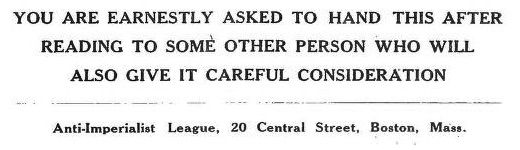
“This outrage unhappily is only one in a series.”
* * *
And it begins,
“for the problem of the Twentieth Century is the problem of the color-line.”
Here, in the first paragraph of his epochal 1903 volume, The Souls of Black Folk, the scholar and activist W.E.B. Du Bois lays down the claim that would bind his own life to the course of an era.[1]
After this warrant of an introduction, Du Bois repeats the phrase twice more in the book.
“The problem of the twentieth century is the problem of the color-line,”
begins his second chapter, “Of the Dawn of Freedom,” and he continues with a brief gloss on the phrase:
—the relation of the darker to the lighter races of men
in Asia and Africa, in America and the islands of the sea.”
But this is only meant as a way of framing the history his essay recounts, of the unfinished work of post-Civil War reconstruction, as you may see by the repetition in the chapter’s closing words:
“The problem of the Twentieth Century is the problem of the color-line.”
Three years earlier, in London, at the landmark First Pan-African Conference of 1900, Du Bois authored a collective statement, “To the Nations of the World,” which also established its grounds by proclaiming,
“The problem of the Twentieth Century is the problem of the color line,”
or, slightly more effusively,
“the question as to how far differences of race,
which show themselves chiefly in the color
of the skin and the texture of the hair,
are going to be made, hereafter, the basis
of denying to over half the world
the right of sharing to their utmost ability
the opportunities and privileges of modern
Though the statement explicitly addresses “the Great Powers of the civilized world,” its greater aim is to conjure into presence a collective speaking subject, “the men and women of Africa in world congress assembled,” capable of articulating its own political interests. It invites “the millions of black men in Africa, America and the Islands of the Sea” less to hear themselves addressed than to hear this voice as their own.
You may have recognized by now that the power of this statement may have something to do with repetition. And if you have any familiarity with writing on the topic of race, you’ve heard it quoted more times than you care to remember, usually at the introduction or conclusion to a book or lecture or essay.
This iterability was no accident. Du Bois understood the political force of a “pert and singing phrase”—he could have accomplished a lot with Twitter—and the genius of this formulation is that it does much of its work whether or not its speakers understand what they are repeating. In fact, it seems he was quoting himself the whole time.
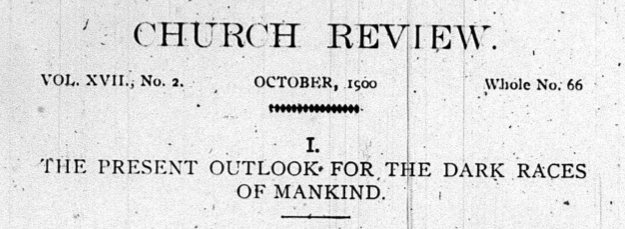
As far as scholars have been able to determine, the origin of Du Bois’s famous color-line formulation is a little-known address he delivered on December 27, 1899 in Washington, D.C., to an organization of intellectuals, the American Negro Academy. The phrasing is not quite as succinct and elegant in this text—it takes him over a paragraph to get to the first version:
“the color line belts the world and the social problem of the twentieth century
is to be the relation of the civilized world to the dark races of mankind,”
and the payoff, a few pages later, still walks with a hitch:
“the world problem of the 20th century is the Problem of the Color line.”
Yet a full reading of this text is a revelation, for here the formulation is no mere catchphrase, but the thesis of an argument to be carefully explained and established. This thesis is the prophecy of an Afro-Asian century. And its occasion is the Philippine-American War.
* * *
“this civilized Christian nation is expected to rejoice”
* * *
The Afro-Asian century begins here, but this beginning was easy to miss.
The address in D.C., truth be told, was a relatively minor episode in an utterly wrenching year for the Atlanta University professor. On one hand, Du Bois’s academic career had reached new heights, repaying years of struggle. He was contemplating a generous offer of employment from the most powerful black man in the country, Booker T. Washington—soon, he’d become known as Washington’s greatest adversary—and holding out for better.
On the other hand, he was shaken by the nearby lynching of Sam Hose that April, an atrocity that reverberated from Georgia as far as Luzon, as I discussed in an earlier post. Du Bois’s close encounter with the public display of a gruesome trophy from Hose’s killing fractured his faith in his scholarly endeavors.
One month later, he witnessed the brief illness and death of his son Burghardt, barely two.
(White doctors in Atlanta would not treat black patients, and black physicians were in short supply.)
Meanwhile, lynching—as the Sam Hose case illuminated—found its analogue in the brutal violence of the American war of conquest in the Philippines. As a sequel to the conflict with Spain, the war quickly became unpopular among African Americans, who recognized its white-supremacist underpinnings. But few held much hope that this resistance would prove effectual.
Stepping back, it is difficult not to imagine this moment as one of despair—of the rise of Jim Crow and of empire, of what seemed to be the final betrayal of the hopes of Reconstruction. The African American historian Rayford W. Logan would later famously term this broader era, “the nadir.”
In the definitive two-volume biography of Du Bois by David Levering Lewis, the 1899 address does not merit a mention. The sole book-length history of the American Negro Academy even contradicts itself, in a single chapter, on the question whether Du Bois even attended the year’s meetings.[2]
* * *

Jauntier days:
Going over Niagara, 1905
Library of Congress
* * *
The only extant text of Du Bois’s 1899 address, “The Present Outlook for the Dark Races of Mankind,” was published the following autumn in the Church Review, an A.M.E.-affiliated journal edited by Hightower T. Kealing. A whirlwind survey of “the problem of the color line […] in its larger world aspect in time and space,” it guides its readers through analyses of racial conflicts across five continents, and of world-historical dynamics over four centuries.
Beginning in Africa, and traveling across Asia and the Pacific to South America and the U.S., it culminates in Europe, where he lays down his now-famous thesis. The color line, it turns out, is not a bar to be lifted or crossed over, but a traveling analytical concept for considering how race is made and remade, in uneven and unpredictable ways, across a global field of imperial competition.
The problem of the color line, as Du Bois defines it, is a crisis of accelerated geopolitical competition that generates intensified processes of racialization within imperial states, at their borders and at their centers. Race, in this crisis, is a something like a technology for legitimizing both conquest and mastery, in putatively biological and cultural terms. But because its ultimate horizon is global—because race provides a language of justification and justice that extends beyond the reach of any one imperial power—it offers the possibility of unexpected forms of connection and correspondence from below.
In short, the problem of the color line means that the very justifications of world-grasping white-supremacist imperialisms provide the terms for racialized minorities and colonized populations to construct relations with each other to overcome their domination by Europe and “Anglo-Saxon” America.
For Du Bois and his American Negro Academy audience, he asserts, the revelation of this possibility is given by the very event dominating newspaper headlines and black public and private debates: the Philippine-American War.
Though he explicitly opposed it, here he takes conquest as a fait accompli, in order to imagine adding eight million Filipinos, along with a lesser number of other new colonial subjects, to a population of nine million African Americans:
“But most significant of all at this period is the fact
that the colored population of our land is,
through the new imperial policy,
about to be doubled
by our ownership of Porto Rico,
and Hawaii,
our protectorate of Cuba,
and conquest of the Philippines.
This is for us
and for the nation
the greatest event
since the Civil War.”
This revelation allows Du Bois to imagine an antiracist coalition under empire:
“Negro and Filipino,
Indian and Porto Rican,
Cuban and Hawaiian,
all must stand
united
under the stars and stripes”
[.…]
“nearly twenty millions
of brown and black people
under the protection of the American flag
a third of the nation”!
But this new situation establishes a greater moral responsibility upon his fellow African Americans, on whose leadership depends not only “the ultimate destiny of Filipinos, Porto Ricans, Indians and Hawaiians,” but also “in a large degree the attitude of Europe toward the teeming millions of Asia and Africa”—
“No nation ever bore
than
we black men of America,
and if the third millennium of Jesus Christ dawns,
as we devoutly believe it will
upon a brown and yellow world
out of whose
advancing
civilization
the color line has faded
as mists before the sun—
if this be the goal
toward which
every free born American Negro
looks,
then mind you,
my hearers,
its consummation depends
on you,
not on your neighbor but
on you,
not on
Southern lynchers
or Northern injustice,
but
on you.”
* * *
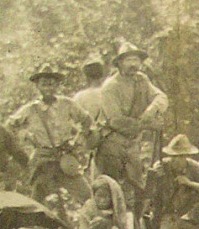
“Thus we teach the Filipinos what American civilization means.”
* * *
But if Du Bois saw American Negroes—rather than American Anglo-Saxons—as the bearers of a liberating civilization to nonwhite peoples around the world—
“German Negroes, Portuguese Negroes, Spanish Negroes,
English East Indian[s], Russian Chinese, American Filipinos”
—there remained one exception to this vision of a “century [of] striv[ing], not by war and rapine but by the mightier weapons of peace and culture”:
“The one bright spot in Asia to-day”—
“the island empire of Japan”—
whose rising geopolitical profile was
“the greatest concession to the color-line
which the nineteenth century has seen.”
Reflecting on Russia’s designs in northeast Asia, Du Bois muses, “Perhaps a Russia-Japanese war is in the near future,” and adds, “At any rate a gigantic strife across the color line is impending during the next one hundred years.”
Within five years Russia and Japan were at war, and Du Bois was quick to trumpet the sentiment that made Japan a sympathetic figure among African Americans for the next four decades:
“To-day
for the first time
in a thousand years
the great white nation
is measuring arms
with the yellow nation
and is shown
to be distinctly
inferior
in civilization and ability.”
Half a century later, in his celebrated essay “Stranger in the Village,” James Baldwin famously concluded,
“The world is white no longer, and it will never be white again.”
A devastating observation, Baldwin’s words, coming just a few years after WWII, brought a new world into focus, as if waking the reader from a dream. But in 1905, Du Bois’s words were a prophecy:
“The foolish modern magic of the word ‘white’ is already broken.”
As I discussed in the previous posts in this series, the deep current of pro-Japanese feeling among black communities that took off after the Russo-Japanese War—that burgeoning speculative imagination that dreamed of an Asian champion of the colored races—had already gone out of style among black elites before its suppression in World War II.
Although a younger cohort of black intellectuals, turning to Marxism in the 1930s, took up the cause of China against Japanese imperialism, Du Bois preferred to use condemnations of Japan as illustrations of the hypocrisy of the white powers. Indeed, at the same time that Robert Johnson was recording “I Believe I’ll Dust My Broom” in that San Antonio hotel room, Du Bois was surveying conditions firsthand in Japanese-controlled Manchuria.
Du Bois has been accused, justifiably, of functioning as a credulous apologist for Japanese imperialism. Yet his larger theme was actually vindicated by World War II. The conflict between Japanese and U.S. imperialisms across the Pacific was contested, not only militarily, but in ideological claims to be the bearer of racial justice. However disastrous Japan’s claims proved for other nonwhite populations under its sway, they helped create unprecedented openings that were seized, during the war and afterwards, by anticolonial and black freedom movements around the world.
This is the story of the Afro-Asian century—of the narrative that identifies the social and political advances of black and Asian peoples as the defining event of the 20th century, and that takes the jaggedly articulated strivings of metropolitan minorities and imperially subjugated populations of color as its indispensible condition. From the Philippine-American War to World War II, it is the story of a looming challenge, a rising tide; from the War in the Pacific to the fall of the Soviet Union and the call to a New World Order, it is the story of rapid transformation.
More than a heroic tale of coalitions or alliances, the story of the Afro-Asian century is a matter, often coldly pragmatic, of aligned geopolitical interests. Such a distinction was central to Du Bois’s own thought, for he always took care to distinguish his uncompromising ethical demands from his unsentimental analyses of the vicious and unpredictable operations of global power.
* * *
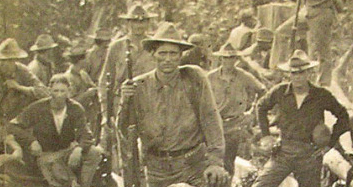
“The spirit which slaughters brown men in Jolo
is the spirit which lynches black men in the South.”
* * *
In 1907, Du Bois wrote a letter to Moorfield Storey, the white Boston anti-imperialist who would later serve as the first president of the NAACP, commending a recent pamphlet against U.S. imperialism in the Philippines. Would be possible, he asked to obtain a larger reproduction of the accompanying photograph, which depicted U.S. soldiers posing triumphantly over piles of slaughtered Filipinos in the aftermath of a massacre at Bud Dajo?
“I think that picture is the
most
illuminating
thing
I have ever seen.
I want especially to have it framed
and put upon the walls of my recitation room
to impress upon the students
what wars and especially
Wars of Conquest
really mean.”
Du Bois request proved to be impractical.
I have not been able to determine which image he was specifically referring to, of the various images of the atrocities that are readily available. But, as I have less faith than Du Bois in the self-evident operation of images of violence, I have chosen not to reproduce one in full here, though I have included selected details above.
After all those viral videos of black people killed by police—and after Abu Ghraib, after Rodney King, after Emmett Till—it is difficult to maintain any faith in a straightforward relation between the reproduction of an image of violence and its amelioration. (All these images are not so hard to find; begin here, if you wish.)
Yet Du Bois must have known this, for already in his time, photographs of lynching were circulating, as postcards and souvenirs, tokens of the violence of white imperial race-making, no less than the very knuckles of Sam Hose, whose public display, on Mitchell Street in Atlanta in 1899, he had rightly escaped, a line of detour or flight whose unfinished extension would span a century.
* * *
The Afro-Asian century begins, with the grandest of hopes, in conditions of overwhelming violence.
“The spirit which slaughters brown men in Jolo,” Moorfield Storey wrote—it could as well have been Du Bois—“is the spirit which lynches black men in the South.” But even those grandest hopes pinned themselves to the revolutionary fulfillment of imperialism’s own justifications.
The lost Afro-Asian century begins on the far side of despair, with a bitter joke.
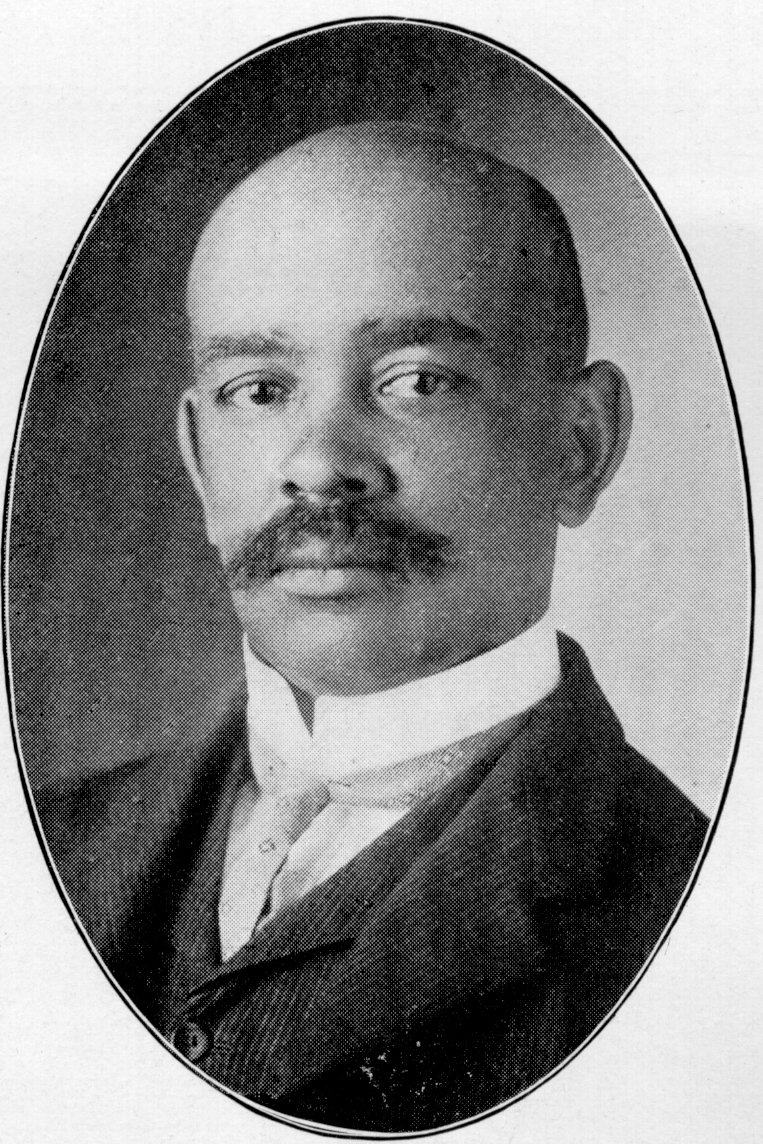
Prof. H.T. Kealing,
from H. Talbert's The Sons of Allen, 1906

Tracing the unexpected origins of a statement as famous as Du Bois’s thesis on the color line can be thrilling, if you’ve caught the bug for this kind of thing. But the most disorienting moment in all my years of studying Du Bois came when, after locating an electronic copy of the issue of the Church Review in which his text appeared, I skimmed through to the end.
There, I found a series of editorials, some longer than a page, others pithy and aphoristic as the one shown above. Presumably written by the journal’s editor, H.T. Kealing, they evidenced a hard-boiled irony and cutting wit that could feel timely fifty or a hundred years later—and that reminded me, again, how deliberately old-fashioned Du Bois’s writing voice was, even in his own time.
Even more striking was the ease with which the writer moved from local events to nuanced analyses of developments across the globe. This geopolitical awareness, I would come to learn, was not specific to Du Bois or to Kealing, but shared by a wide range of African American writers and readers, to a degree likely beyond the average educated citizen of the U.S. in 2015.
Yet these analyses were as troubling as they were impressive. For example, a reflection on three ongoing imperial wars, in China, the Philippines, and South Africa, bluntly condemns the intentions of the great powers as “undeniably and declaredly selfish and sordid,” yet upholds their core justification—
“the rape of Africa, Asia and the islands
will open them up to Western progressiveness, invention,
comfort, personal liberty and the Christian religion”
—a process culminating in
“the elevation and equalizing of the protesting semi-savage”
and even, one day,
“his domination
in things commercial, literary, artistic, and economic,
over the Western world”!
The difference between this analysis and Du Bois’s color-line thesis, I finally realized, is for the most part rhetorical. Where Kealing endorses imperialism’s justifications with a curse, Du Bois offers an inspirational exhortation.
By rhetorical, I do not mean inconsequential. While they express the same analysis, they do so to quite different effect. Kealing also had a way with words, but Du Bois’s formulation traveled far beyond the limits of the analysis that produced it, becoming a great watchword of antiracist and anticolonial struggle.
Here on the far side of Du Bois’s prophecy, however, I find myself more and more drawn to another of these editorials. It reads:
“If Aguinaldo were the statesman he is reputed to be, he would form an alliance
with King Menel[i]k of Abyssinia and do something worth while.”
In this statement, the dream of Afro-Asian liberation, joining the leader of the Philippine resistance to the hero of African opposition to Italian imperialism, can be expressed only as a sarcastic counterfactual. It comes into view only after it is already deemed impossible.
You may recall an even more daring example of this variety of rhetoric in a passage, cited in an earlier post, by the militant A.M.E. Bishop Henry McNeal Turner, speaking bravely, if not recklessly, against black soldiers’ participation in the war:
“I can scarcely keep from saying
that I hope the Filipinos will
Like Turner, Kealing is versed in the languages of the politically unspeakable and ethically impossible. His conception of racial justice cannot be extricated from the imperialism against which he would turn it, and so the best rhetorical figure he can find to evoke the volatility of this paradox is a bitter joke.
This is where the lost Afro-Asian century begins. The century of a desire always negated.
You know where it ends, don’t you?
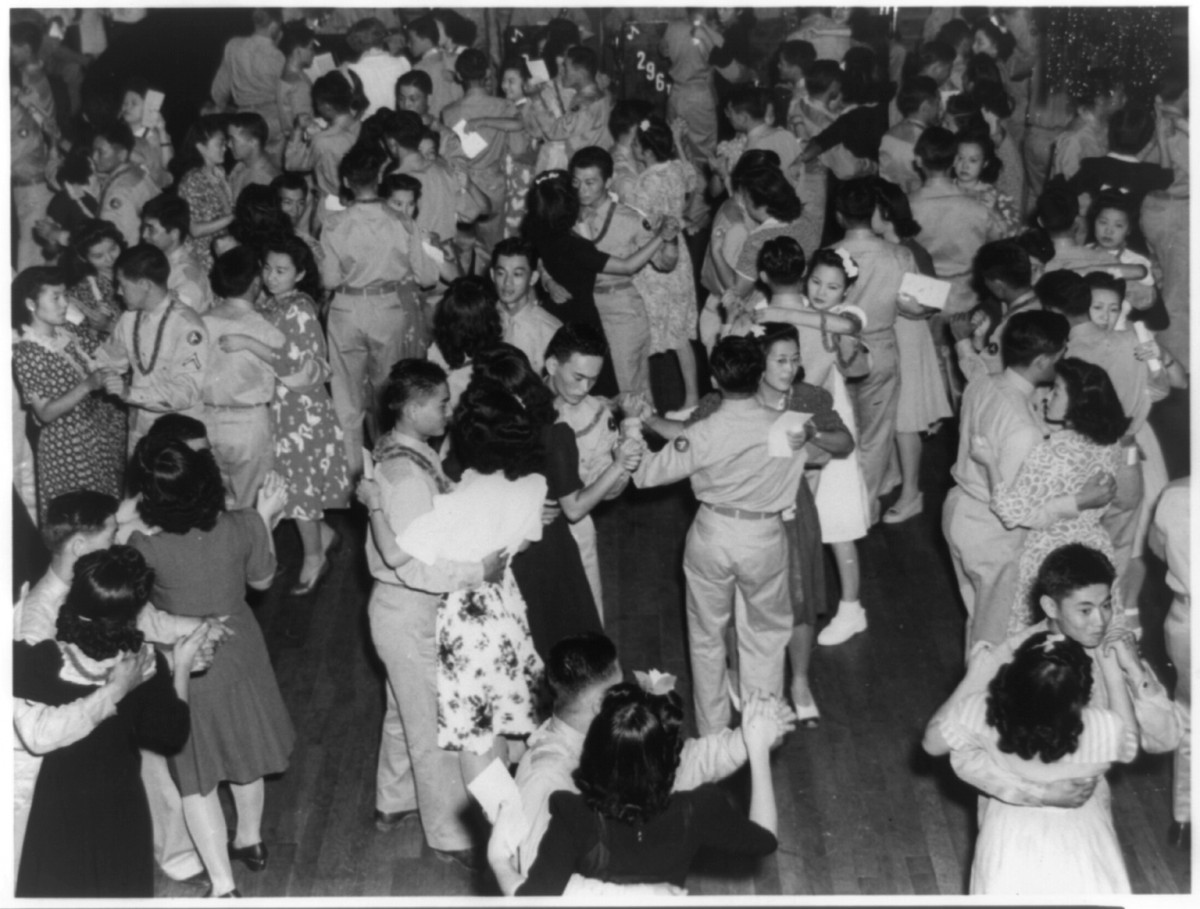
Camp Shelby, Miss, 1943
Soldiers with inmates from Rohwer and Jerome, Ark.
Library of Congress
Welcome to the City of Refuge! Next week, head back with me to Chicago to look for a way out.
New posts every Wednesday, through the end of the year. Read with me, and tell me about it—a comment section should appear below if you’re signed in to Facebook, but you can always reach me here and here.
[1] The Souls of Black Folk is a stunning work on its own terms, but, much like the phrase I’m discussing, it’s as much a talisman as a text. The Dr. Du Bois whose massive public influence on the 20th century has been condensed into this talisman came into his more militant voice as the editor of the NAACP’s The Crisis. His genre-bending 1940 memoir Dusk of Dawn is my preferred starting point, but I try never to introduce anyone to Souls without recommending his 1910 essay, “The Souls of White Folk,” which appears in his 1920 collection, Darkwater.
[2] Fortunately, the address has recently been reprinted in an invaluable collection by the most assiduous scholar of Du Bois’s early writings, Nahum Chandler.
Part four in a continuing sequence on the geography of the lost Afro-Asian century. For earlier posts, scroll down.
When you live in a falling empire, reading the news is doubly uncanny—like déjà vu, combined with the unsettling premonition that somewhere, the ending that should seem so familiar has been changed.
* * *
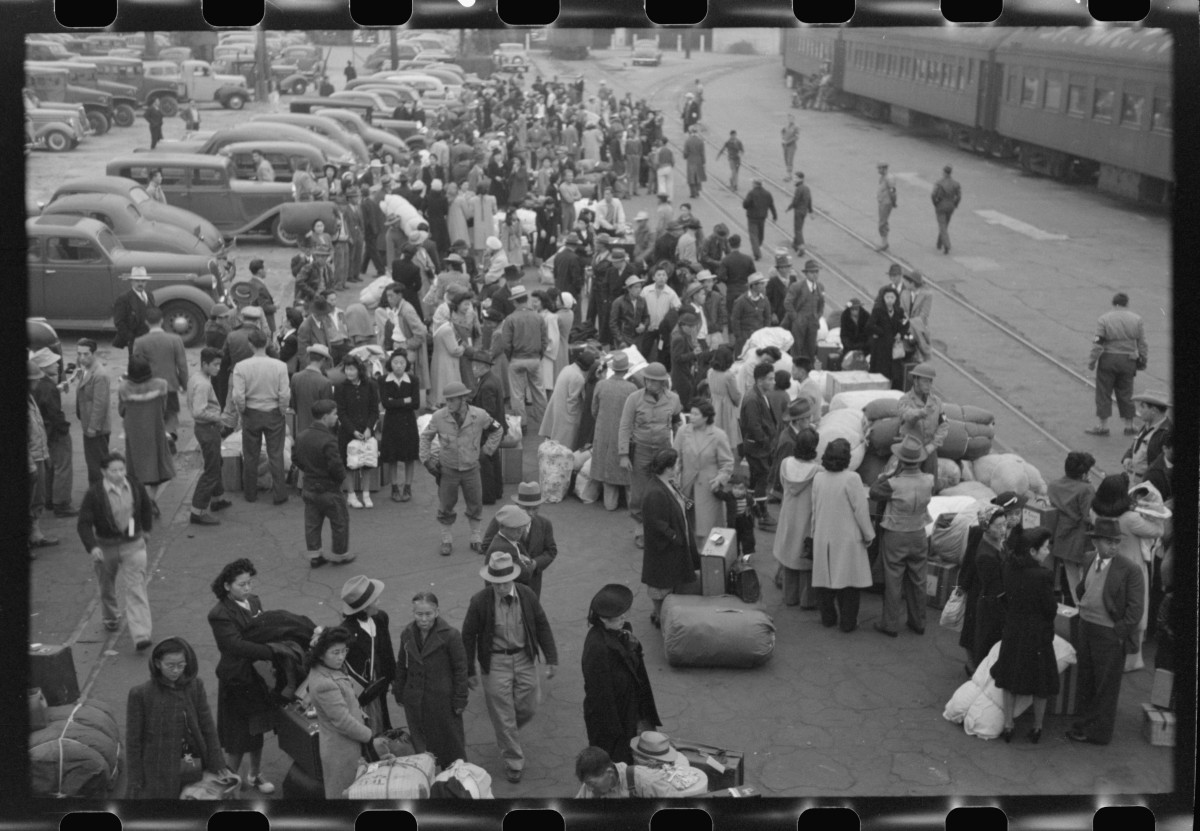
deeper into America
April 1942
image from Library of Congress
* * *
This is an essay on the geography of the lost Afro-Asian century, but it is also a personal history. So for me, Chicago is its capital, where everything comes for its ending. Yours might be San Francisco or Havana, Manila or Addis Ababa, Honolulu or Paris, New Orleans or Tokyo; the color line belts the world, and the Afro-Asian century always wore its geography loosely.
But it must be admitted that the Afro-Asian century was always the other side of the American Century, that to speak of one is to conjure the other, for each is the other’s specter and haint. If I have any warrant for laying claim to your attention with more stories from inside the empire’s belly, it is that every world is only the occasion for all the lost worlds thronged upon it.
As always, I pray for this writing to give way to all those histories I cannot know.
* * *
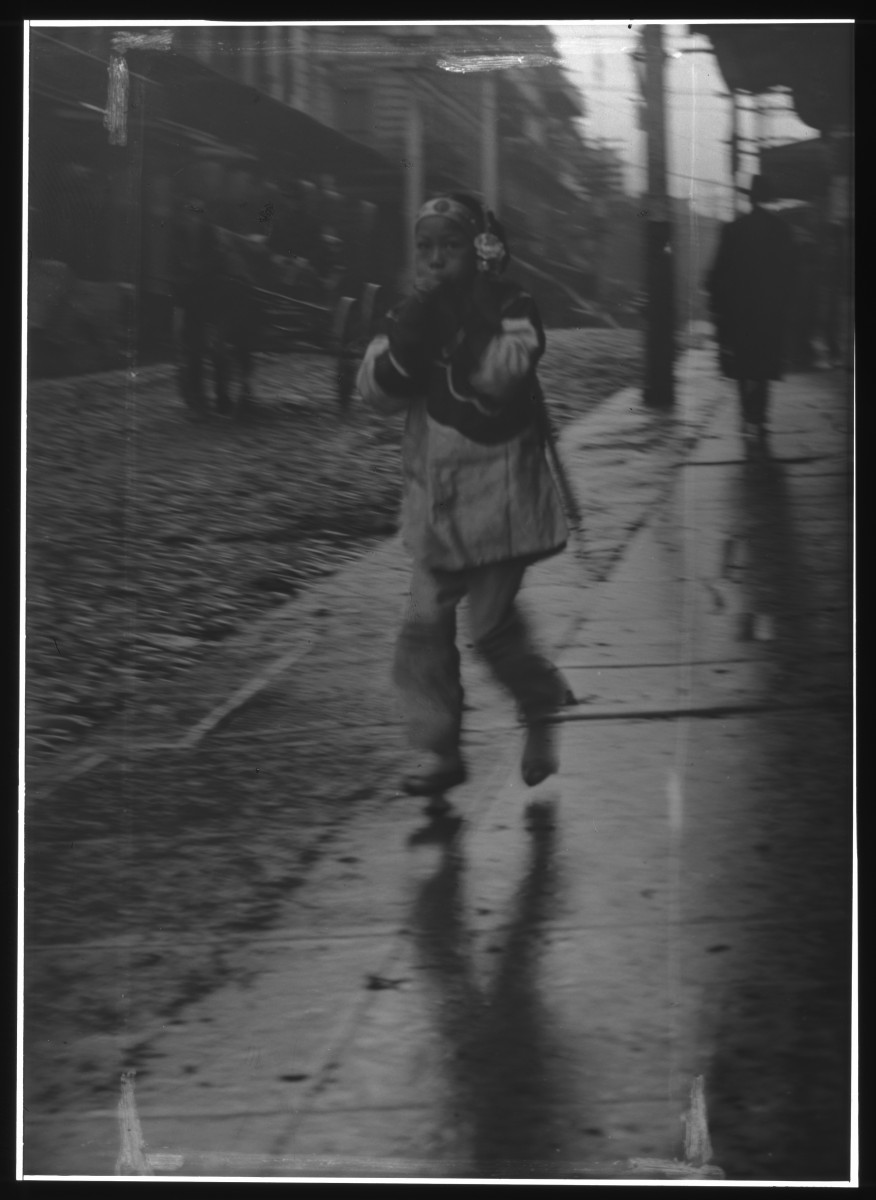
San Francisco before the earthquake
image from Library of Congress
via Digital Diaspora Family Reunion
* * *
If the story of the 20th century is that of the linked social and political advances of black and Asian peoples around the world, it is also that of U.S. global ascendancy. The Afro-Asian and American centuries rose together, challenging a geopolitical order dominated by European empires, which reached its breaking point at World War II.
In the subsequent decades, U.S. global power has been justified specifically in relation to the challenges presented to it by black and Asian peoples. U.S. hegemony over the world is benevolent, the argument goes, because America is anticolonial, the guarantor of formal equality between nations. This is despite its settler-colonial status, its domination of other states’ affairs, and its long, unfinished series of wars and military operations in East, Southeast, and West Asia and elsewhere.
And U.S. power is benevolent, because America’s foundational commitment to formal equality between individuals recasts the history of U.S. racism as American sponsorship of racism’s overcoming. This proposition has been promoted around the world, again and again, even in moments when domestic racial conflicts were breaking open through violent urban uprisings.
It is one of the ironies of the color line, as W.E.B. Du Bois understood it, that exercising imperial power abroad tends to require increased promises of racial justice at home. This may be what that old trickster Ron Takaki meant when he cheerily asserted, “Diversity is America’s Manifest Destiny.” Even so, in both colony and metropole, the operation of racial justice has often been indistinguishable in practice from overwhelming violence.
* * *
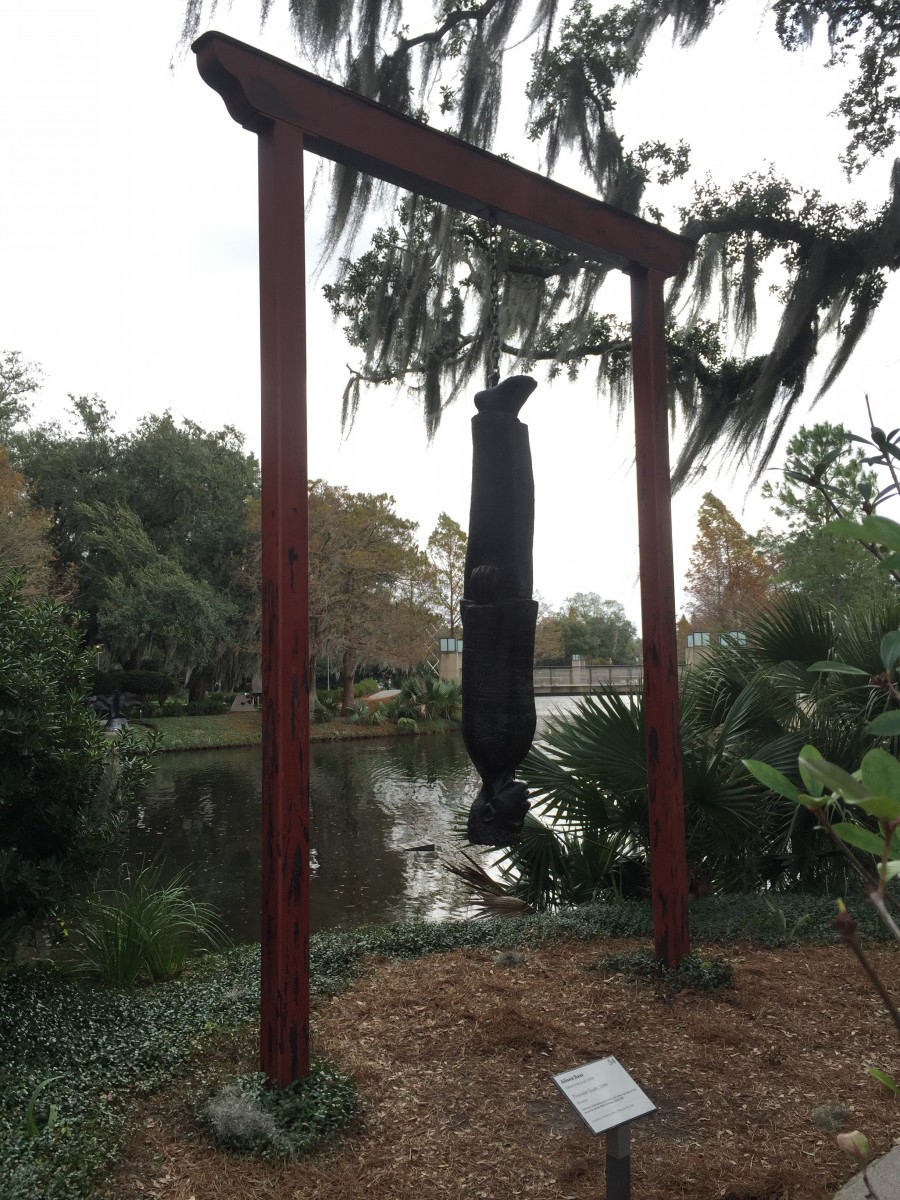
visiting New Orleans
Christmas 2015
Alison Saar, Travelin’ Light, NOMA
* * *
The most direct challenge to this account of the American century—of U.S. global rule as the gradual and inexorable expansion of freedom—was also the most explicit manifestation of the Afro-Asian century within U.S. metropolitan borders.
Today, the idea of a Third World Front, linking Black, Brown, Yellow, and Red Power movements in the U.S. to revolutionary struggles in Asia, Latin America, and Africa, feels like a relic of 1960s radicalism. But the scope of its disruption of the U.S. racial order is rarely acknowledged, and its influence lingered long after the geopolitical conditions that made it possible had faded. (No, really.)
At its best, U.S. Third Worldism was an insistent practice of comparison and connection, uncovering links between all those histories scattered into diversity by empire. For example, in the May 1973 issue of the Asian American movement newspaper Gidra, Mike Murase reported on the declaration of the Manzanar concentration camp site as a California Historical Landmark. Rather than simply celebrating this minor victory, Murase took the occasion to outline a theory of U.S. imperial “relocation” from the 1830 Indian Removal Bill to Japanese American incarceration, military bases in Okinawa, the bombing of the Vietnamese countryside, and the American Indian Movement struggle at Wounded Knee.
“Manzanar has no geographic boundaries and is not bound by time,” Murase wrote.
The dream of Third World liberation persists these days in forms of negation—as something so outdated and outlandish, you can merely shake your head, or laugh. Among its legacies is an oddly unquestioned assumption that antiracism and anti-imperialism necessarily work in tandem. But from Iraq to Manila, U.S. imperialism has long presented itself as the vehicle of racial justice, even as anti-imperialism has occasionally been championed by white supremacists.
* * *

this essay needs more feminism
image from Gidra via Densho
* * *
Stranger still is the idea that the American century and the Afro-Asian century might have been one. As late as 1943, Carlos Bulosan still dreamed of this possibility.
In the November 8 issue of the New Republic, he published an open letter to the wife of the brilliant literary critic Salvador P. Lopez.[1] Linking the Philippine resistance to Japanese occupation and proletarian struggles in the U.S., all within the broader world war, he asserted a claim on America in the name of all of its history’s lost:
“It is but fair to say that
America
is not
a land
of one race
or one class
of men.
We are all
America
that have toiled
and suffered
and known oppression
and defeat,
from the first
Indian
that died
in Manhattan
to the last
Filipino
that bled to death
in the foxholes of Bataan.”
In Bulosan’s dream, all these lost worlds might yet be found, because the American century might yet be the coming of the revolution:
“America
is not bound
by geographical latitudes.
America
is not
merely a land
or an institution.
America
is in the hearts
of men
that died for freedom;
it
is also in the eyes
of men
that are building
a new world.
America
is the prophecy
of a new society
of men:
of a system that knows
no
sorrow or
strife or
suffering.”
In his hope that the story of American nationalism might be redirected into the realization of proletarian revolution, Bulosan was hardly alone. Yet his distinctive, relentless emphasis on a collectivity of defeat remains strangely moving:
“America
is also
the nameless foreigner,
the homeless refugee,
the hungry boy begging for a job and
the black body
dangling
from
a
tree.
America
is
the illiterate immigrant
who is ashamed that
the world of books
and intellectual opportunities
is closed
to him. We
are all
that nameless foreigner,
that homeless refugee,
that hungry boy,
that illiterate immigrant and
that lynched black body. All
of us,
from
the first Adams
to
the last Bulosan,
native born
or
alien,
educated
or
illiterate
Three years later, in his “personal history,” America Is in the Heart, Bulosan would repurpose this passage as a stirring speech by the narrator’s brother “Macario” to a group of radical Filipino migrant laborers in the 1930s. This new context ought to help clarify what’s so remarkable about Bulosan’s claim.
As the broader, fictionalized memoir demonstrates, the protagonist, standing in for Filipino migrant workers as a whole, has experienced each of the archetypal conditions of suffering gathered together in the name, America. Xenophobia, homelessness, exile, hunger, poverty, restricted access to employment and education, an extravagantly sexualized racial violence characterized by panic over relations between white women and nonwhite men—these are the processes that define what it means to be Filipino in the metropole in the 1930s.
When he writes,
We are America!,
Bulosan is not claiming inclusion in a community defined by tolerance
(We too are America!).
He is asserting the rhetorical seizure of an imperial nation by its colonial excess—
America will be ours!
—by those exploited and stigmatized laborers who mean little to elites on either side of the Pacific, but who appear messianically as the culmination of that nation’s manifest destiny.
Nonetheless, the book’s notoriously dizzying ending suggests that, by 1946, he knew that he was writing an elegy for this vision—albeit a defiantly hopeful one. For Bulosan, this determined hopefulness was matched only by his fidelity to a Filipino migrant labor aesthetic of failure and loss.
The American century and the Afro-Asian century had finally arrived, and if they were joined together, it was still necessary to pick a side.
For a Bulosan, or for a W.E.B. Du Bois, the choice, if there was one, had already been made. Harrassed and persecuted by the FBI during the anti-Communist campaigns of the early Cold War, both men entered the twilight of their careers, their influence reduced to increasingly isolated radical circles. Though they presumably never met in person, they did in paper, as two of six signatories to a letter issued by a committee sponsoring the publication of the autobiography of the Hukbalahap movement leader Luis Taruc.
There are worlds within worlds. Who is to say that one is lost and not another?
* * *
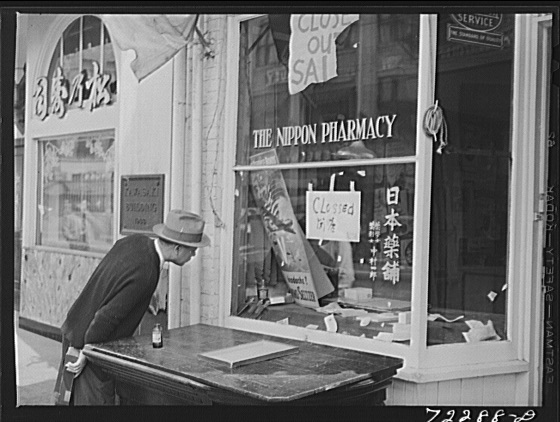
shutting it down in Los Angeles
April 1942
image via Library of Congress
* * *
The Afro-Asian century always wore its geography loosely.
America is not bound by geographical latitudes.
This is a trick it learned from imperialism, to disdain the inconveniences of borders, which operate in an order that can never claim it as its own.
Manzanar has no geographic boundaries and is not bound by time.
Even time is no master, for a century is not a fixed period, but a figure. When W.E.B. Du Bois deleted the word, “world,” from his initial formulation,
the world problem of the 20th century is the Problem of the Color line,
this was justified by redundancy. In his account, to speak of a century is already to think in global terms, for a century is less a fixed term of one hundred years than a unit of world-historical time.
But the great Martinican poet and politician Aimé Césaire, writing in 1955 amid the geopolitical transformations of the post-World War II order, cut the American century down to size, stating:
“The hour of the barbarian is at hand. The modern barbarian. The American hour.”
* * *
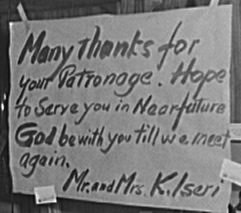
Little Tokyo, LA, April 1942
image via Library of Congress
* * *
However short or long, the Afro-Asian century, like the American century, has already come to its end.
And if it is still possible to speak of the problem of the 21st century, in the world-historical terms pronounced by Du Bois, it will not be the problem of the color line. Racism and colonialism may persist in older forms and prove resurgent in new ones, but race no longer appears to provide the dynamic link running through the social conflicts currently driving long-term geopolitical transformation.
The color line is not the problem of the 21st century. It is the problem of a century that ended but is far from over.
Similarly, the American century may have ended, but as U.S. imperialism staggers on in its zombie phase, strength in refuge might yet be found in the elusive worlds of the lost Afro-Asian century.
* * *

for the lost and where we may join them
New Orleans, Christmas 2015
(Alison Saar, Travelin’ Light, NOMA)
Almost there! One more station left on this line. If you’ve followed along this far, I’d love to hear from you. A comment section should appear below if you’re signed in to Facebook, but you can always reach me here and here.
[1] Although Bulosan believed that Lopez had been killed by the Japanese military, he survived the war to become a distinguished diplomat and university president.
The final installment in a sequence on the geography of the lost Afro-Asian century. Scroll down for earlier posts.
I am looking for a map to everything that comes after the ending.
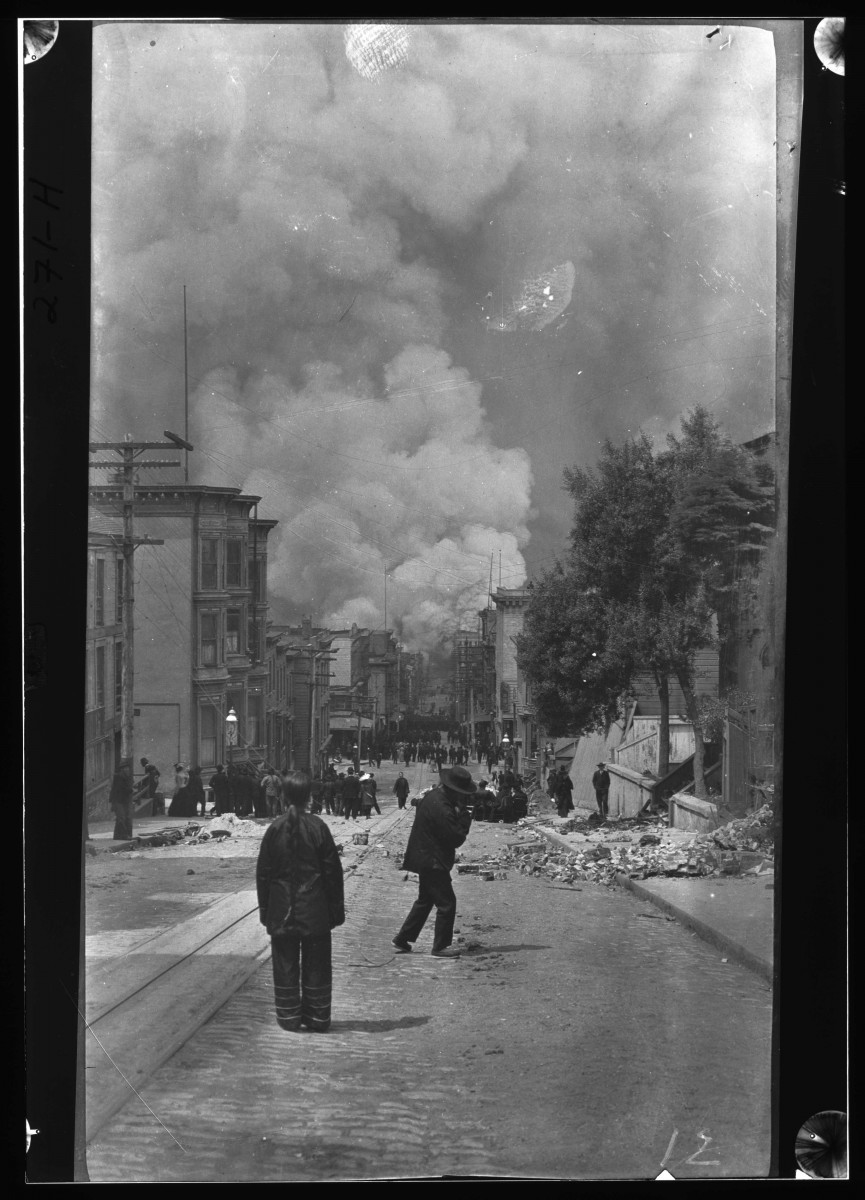
worlds within worlds, each one lost
image from Library of Congress
via Digital Diaspora Family Reunion
* * *
When a world falls, its vision starts to fracture, a whole regime of perception shudders and begins to give way. All you have ever known as justice, blooming over with a lattice of violence.
By the law that binds us, swears the prosecutor, but his actions demonstrate that he imagines its constraints fall on an order of life different from his own. So he must believe he is himself the law, for he will sacrifice a child to preserve the impunity of the law’s agents.
It is cold comfort to know that he is doomed to misperceive this impunity as freedom, enthralled by a wretched shadow. Harder to resist wishing that he might learn for himself what it means to have the agents of justice visit your door.
* * *

lost Afro-Asian worlds
New Orleans, Christmas 2015
Alison Saar, Travelin’ Light, NOMA
* * *
When did the Afro-Asian century end? China is ascendant and India is rising, but whatever this may mean for the world, it does not signify liberation. Neither did the election of the first (openly?) African American commander-in-chief, however it may have seemed at the time, for his term has defined the termination of a narrative rather than its blossoming—national destiny arriving into a globalized world.
(Even the most sophisticated and unromantic analyst of U.S. racial politics at the time of Barack Obama’s first election has much to learn from those younger protestors who came to political consciousness in a world that already had a black president in it, for they are already living in another story.)
(Nor does it matter much that he is at least as Asian American as Bill Clinton was black, born in Hawai’i and raised there and in Indonesia, the first Pacific president since Taft.)
The Afro-Asian century could not survive the end of the American century, but perhaps it was bound as well to the era of the Soviet Union. It was hard to pretend there were three worlds when the Second had fallen, and so perhaps it died in the first U.S. war in Iraq, floating up as the shadow of a now-dominant multiculturalism, the Third World Front rebranded as people of color.
Or had it already ended by the time Japan had risen anew as an economic power? Or with the end of the US-Vietnam War?
Or, as I suggested in the last post, following the logic of H.T. Kealing’s bitter joke in the very journal where he first published Du Bois’s prophecy of the color line, had it ended before it even began?

memory becomes history becomes an almost-
marketable culture; and then, again, only memory
Little Tokyo, LA, 2015
For me, the end of the story is best narrated in the 1940s, when the geopolitical consequences of World War II transformed the Afro-Asian century and the American century from dreamy promise to quickly hardening realities. The ground was shifting rapidly, under the feet of a Bulosan or a Du Bois, and there was suddenly so much of a world to be gained and to be lost.
For me, the end comes most clearly in Chicago,
with the arrests of Elijah Muhammad, Mittie Maud Lena Gordon, and dozens of others on charges of pro-Japanese sedition;
with the agreement between Ashima Takis and federal authorities that he was not Japanese, but a Filipino named Policarpio Manansala, and that the various enterprises calling themselves Pacific or Afro-Pacific or Ethiopian Pacific movements were just penny-ante confidence schemes preying on poor, ignorant black folks;
with the hiring of S.I. Hayakawa as a columnist for the Chicago Defender;
with the resettlement of loyal Japanese Americans into spaces redefined by Southern black migration, and with the quiet decisions that led many Nisei to regroup in Chicago and seek coalitions with black organizations, defying the prescriptions of liberal policy,
with the formation of those Negro-Nisei coalitions on the suppression of pro-Japanese militancy, a shared secret fracturing those coalitions’ very foundation;
and with the arrival of my own grandparents, a young couple from California, via Poston, Arizona and Camp Shelby, Mississippi, who had already witnessed the death of at least two worlds—their parents’ loss of the immigrant’s spectral homeland, their own loss of the prewar Nisei dream of America—and, soon enough, would be welcoming the birth of their first daughter.
By the time she was grown, Japanese Chicago was becoming a vanishing memory, Watts was on fire, and a Berkeley sociologist had singled out Japanese Americans as a model minority in the pages of the New York Times Sunday magazine. Governor Ronald Reagan appointed Hayakawa president of San Francisco State to put down the Third World students’ strike.
They loved Hayakawa so much in California that they made him a senator. The old wartime liberal found he didn’t have to change his views much as a Republican, but when he spoke out against reparations for wartime incarceration, he was widely denounced in Japanese American communities.
My grandfather wrote a little poem about this, which was published in a newspaper. As I recall, the last line rhymed Hayakawa’s first name (Sam) and trademark headwear (tam) with the word “sham.” I would not be surprised if the two had met, years earlier, in Chicago.
* * *
There are worlds within worlds. Who is to say that one is lost and not another?

a visitor from the future
Little Tokyo, LA
* * *
Afro-Asian radical style of the 1960s and 1970s has persisted in African American popular culture, and nothing that lives in African American popular culture is not consumed all over the world. But another cultural phenomenon, perhaps more vibrant still, descends from Afro-Asian radical consciousness of the first half of the 20th century, even if its Asian (or Oriental) signifiers are often eroded away.
Afro-futurism has been on the rise in the 21st century, particularly after the election of Barack Obama. It is most often grounded, these days, in science fiction and related literary and cinematic genres, and all the practices of fandom associated with them. Afro-futurism is also prominent in the visual arts, both inside and outside the elite institutions of the art world. In a longer view, however, Afro-futurism finds its grounding in the practices and performative mythologies of black musicians Like Sun Ra, Nina Simone, George Clinton, and Janelle Monáe.
To define Afro-futurism in this way, however, is to concede to the processes of description and categorization that anyone familiar with the history of black creative practices should recognize as a prelude to appropriation and commodification. And while Afro-futurism has already been taken down this path, it might also be understood otherwise, not as a category or even as a movement, but as one insurgent dimension of the black radical imagination.
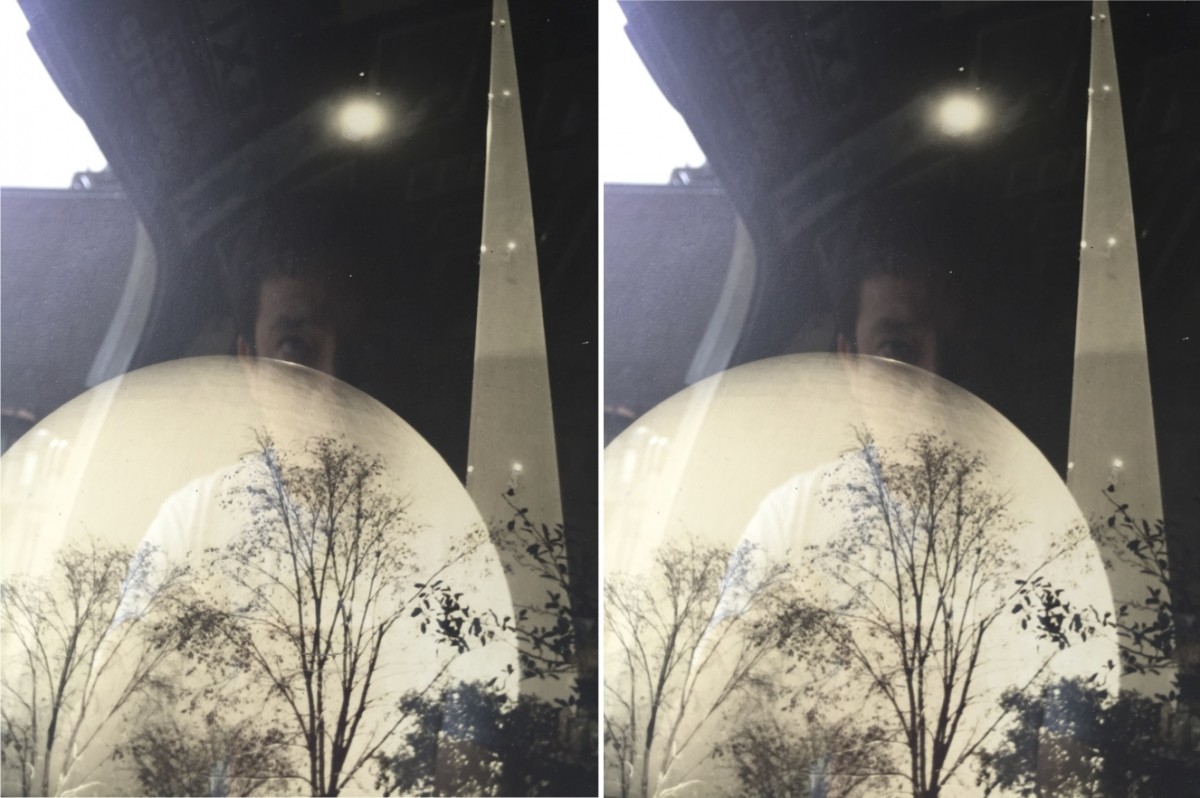
I am looking for a map to everything that comes after the end
The most explicit link between pre-World War II Afro-Asian consciousness and Afro-futurism can be seen in the Nation of Islam traditions teaching about a “Mother Plane,” “Wheel,” or mother ship, likened to a UFO, which derive from Elijah Muhammad’s visions, placing its origins in Japan.
According to Etsuko Taketani, whose scholarship on black interest in imperial Japan is indispensible, a remarkably similar figure appears in an untranslated 1921 novel by the retired Lieutenant-General Kojiro Sato, one of at least two works of speculative fiction by Japanese military officers that imagine crucial African American support in a future war between the U.S. and Japan. In Sato’s novel, ten million African Americans, led by Marcus Garvey himself, take up arms against their government upon the arrival of the fearsome Mother Plane!
A decade earlier, African American writers were already producing similar works of speculative fiction. The journalist John Edward Bruce began a story about a U.S.-Japan race war in 1912, but did not complete it, perhaps learning of another story by the noted writer James Corrothers, along similar lines, published in Du Bois’s The Crisis in December 1913 and January 1914. In both cases, the fantasy of Japanese military superiority to U.S. forces, and of black sympathy for Japan, is initially indulged, before the tide of war is turned by loyal black soldiers won over by the President’s dramatic and personal commitment to civil rights.
Setting aside the potboiler military heroism of Bruce’s and Corrothers’s plots, the analytical point about race relations and transpacific imperial warfare is entirely prescient: Japanese aggression against the U.S. would lead, logically enough, to an unprecedented federal investment in expanding and protecting black civil rights.
But if the Afro-Asian imagination was notable for its geopolitical acuity, the Afro-futurist imagination turns away from the terrestrial altogether. Still, what the two have in common reaches beyond this wretched world. At the most basic level, they express an imperative, not to abandon, but to reimagine blackness in a world beyond white supremacy—to ask, what might racial difference look like if it were finally freed from the dominion of whiteness?
* * *
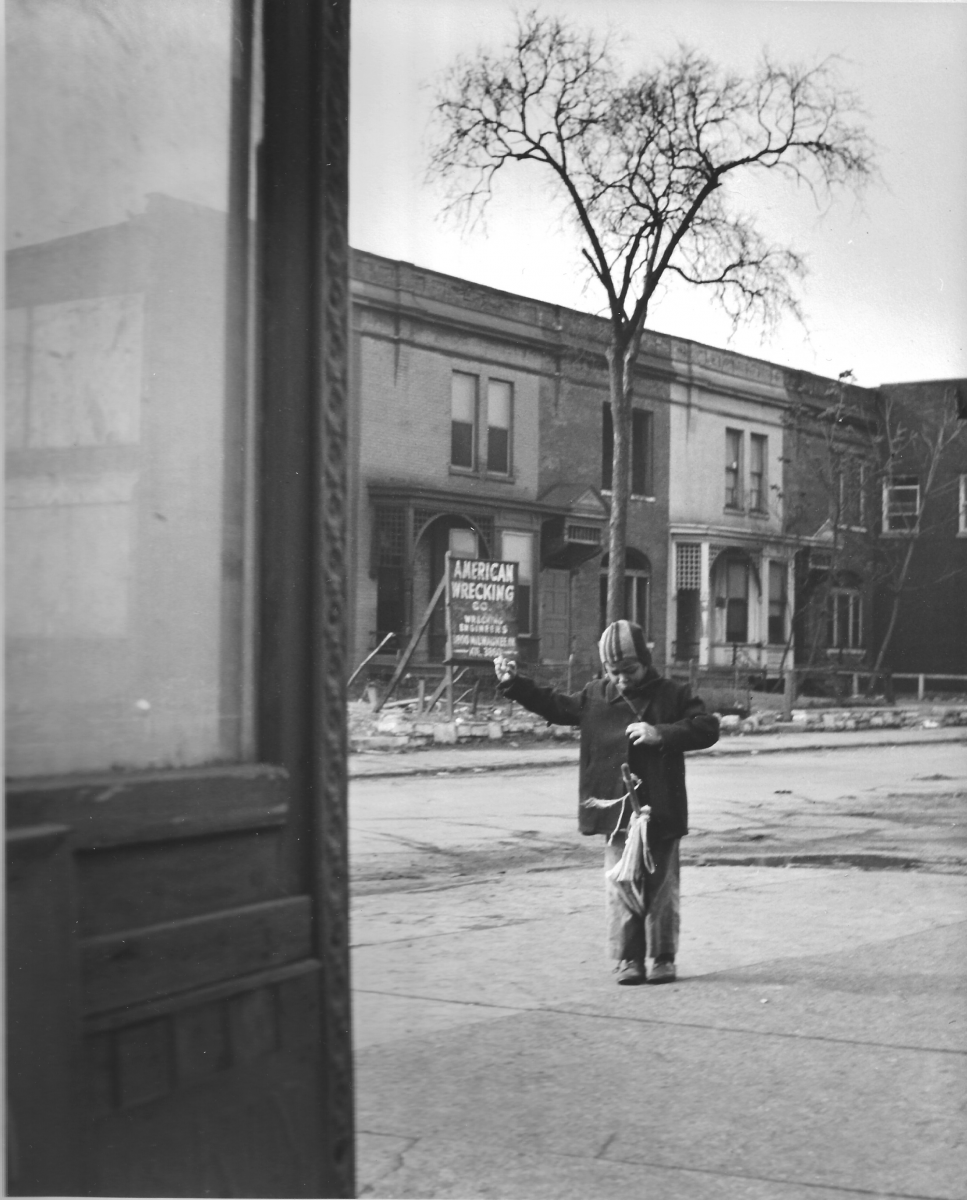
American wrecking, Chicago South Side
Vincent T. Tajiri Estate
I’ve been fascinated by this photo of my grandfather’s ever since I first saw it, and I’ve been meaning to ask if anyone out there can tell me what that child is holding. A newspaper? a toy or tool?
It had not occurred to me that someone might think it was a weapon. I had not realized that virtually every arrangement of a child’s arms might be described as “reaching for his waistband.”
* * *
This is an essay on the geography of the lost Afro-Asian century, but it is also a personal history. So for me, Chicago is where everything comes for its ending, the capital of boundless lost worlds.
Can I still claim Chicago as my hometown, though I’ve never really lived there as an adult? If I return for good, it will mean surrendering the lost city that I know, I know—but I’d do it, as the saying goes, in a heartbeat.
The President also claims Chicago as his hometown. Unlike me, though not born there, he was formed there—at least in the ways that matter, as a character narrated by the collective imagination, and as an organizer of power. Chicago, capital of an Afro-Asian century surely lost.
Make what you will of the President; I am not particularly interested in him, as an organizer of power, except to the extent that his actions might generate openings beyond his control. And I am not particularly interested in him as a character, except to the extent that it can be recognized that authorship of this character can be claimed by others.
But I am not interested in this at all. Nothing about this, at all. I cannot even bring myself to describe it. Click through, and come back quickly.
Instead, I want to leave you with this. It is a performance of the music of Sun Ra, arranged by Frederick Tarpley and presented by the Rich South High School Band in Chinatown Square, Chicago, produced by the brilliant filmmaker and artist Cauleen Smith.
It’s just under eleven minutes, and worth every second, for the music, the images, the faces and gestures of the performers and of the onlookers. I don’t think there’s anything more that I want to say about the lost Afro-Asian century. If you watch this, and forget what I’ve written, that works just as well.
Not here, don’t you know? Space is the place!
* * *
The Afro-Asian century is over. So is the lost Afro-Asian century. But it was always over. And who is to say one world is lost and another not?
Good news!
This planet is doomed.
Farewell, farewell to the City of Refuge! My time here has been too brief. There is so much more I had wanted to read with you and to write about, and again, I’ve been learning so much in this space. But I’m still eager to hear what you think. A comment section should appear below if you’re signed in to Facebook, but you can always reach me here and here.
—traveling outside Memphis, between New Orleans and St Louis, 2015
The regularly scheduled next installment in a three-part sequence on “City of Refuge,” a 1925 short story by Rudolph Fisher, comes tomorrow. Scroll back if you missed the first one; stay tuned for more. Meanwhile, an unanticipated digression:
Anyone who has ever taught understands the temptation to think that standing in the front of a room means you must have something important to say.
So I did not intend to write about an actual refugee crisis, let alone any mass atrocities, in Paris or Beirut or anywhere else. Nor shall I. I didn’t plan, either, on writing about giving refuge, rather than taking it. But I did write that I wanted to consider the difference between safety and refuge.
After I’d written that, I saw that some people were saying that violence teaches that safety requires closing all borders, because you can’t tell the refugees from the enemy. And I saw that other people were saying that you cannot close the borders to refugees who are fleeing the same enemy. And then I felt I ought to try to say something.
To treat refugees as less than human, as less than yourself, is a viciousness. To accept refugees on the condition that they be more than human, more noble and virtuous than yourself, is another manifestation of this viciousness. If you hold U.S. citizenship, as I do, then such demands continue to cast you in shame. An offer of refuge only to those who will be blameless and grateful is the cruelest travesty of generosity. And if you expect the object of your generosity to be better than you, then you should understand they will believe this to be true.
Those who seek shelter know they remain vulnerable to further abuse. When it comes, as it will, and they resist it, will you call them ungrateful? Those who give shelter find, if they did not already know, that the people they have taken in are no better than themselves. When their generosity is abused, perhaps horrifically, will you call them fools and say they had it coming?
To reserve sanctuary for the innocent is to give refuge only to your own self-flattering delusions.
* * *
You, or your relatives, or someone who, with you, is reading these words now, may be or have been a refugee, or might become one; in a strict legal sense, or not; in flight from violence legal or illegal, collective or individual, impersonal or intimate, gradual or spectacular; cast out from your family’s homeland or from your family home.
I have not been a refugee myself, so far, except in ways that might apply to anyone anywhere, or to everyone everywhere. But thinking of refugees and their sheer vulnerability to violence does make me think of my own family.
The world is full of crimes, before and since, that make the incarceration of Japanese Americans in World War II seem a small thing. You might even call Japanese Americans fortunate, given all the ways that episode could plausibly have played out. Even so, the crime has not yet really ended. For decades Japanese Americans have insisted that our incarceration was a crime because we were innocent. And so we have willingly hauled ourselves back into court again and again without ceasing.
But the incarceration wasn’t a crime because we were innocent. No one ever truly believed that all Japs were guilty; they just couldn’t tell a Jap from the enemy. At first they didn’t care to, and then, when they decided to try, it was worse. And if putting the Nikkei in camps had created 120,000 militant supporters of the Japanese empire, it would still have been a crime. The crime won’t end until that is universally admitted.
* * *
Those who offer refuge do not deserve to be repaid with violence. No more and no less do those who seek shelter from it. But to provide shelter to anyone fleeing violence demands that you abandon your own fantasies of safety. These fantasies can no longer be guaranteed by the delusion that your zone of security is not connected to the world of the refugee—connected by lines of violence.
To give refuge is to abandon security for solidarity, to refuse to blind yourself to the violence that never stops coming.
Welcome to the City of Refuge! New posts here every Wednesday, through the end of the year. Read with me, and tell me about it here and here.
Introduction to an ongoing series published every Sunday or so.
1.
All investigators experience a driving urgency to uncover evidence of some sort, useful to make a particular claim. I’ve always wanted to know why, in my experience, Filipinos and Americans might tell personal, isolated stories about one another, about wars, exchange visits, and pop culture, but do not see those anecdotes as having anything to do with the historical relationship forged by U.S. colonialism and empire. This question sent me researching records left behind by the U.S. administrative endeavors to rule over Filipino people. The genre of the quaint little story was found in the archives, for sure, but so were more dramatic narratives about betrayal, ambition, and alienation. Even longing: at one time, the American public seemed avidly interested in what Filipinos thought of the U.S. Since that is not so much the case now, was that interest ever satisfied?
St. Louis Post - Dispatch, August 27, 1904
My poem, “I Was a Twenty-Four-Year-Old Separatist,” relates how I began researching U.S. colonialism in the Philippines. I found a chapter on Filipinos in a 1932 sociology study on Chicago, and realized that Filipinos could pop up anywhere. Filipino young migrant men in interwar Chicago raised enough questions and interest to generate investigation by academics, journalists, reformers, charities, and police. Filipinos’ social and even intimate activities were matters of political and economic importance — and not just to immigration exclusion debates or the white slavery moral panic. Investigations into Filipino interactions, attitudes, and appearances sometimes became an occasion to revisit U.S. colonialism’s claims, several decades old at that point, about the future of the Philippines. This book on 1930s Chicago initiated my research interest in the claims of U.S. empire about Filipino “personality.”
As mentioned in my introductory post, I’ve written poems about my historical sources: my poetry manuscript, Poems for A, has a section about my research experience in U.S. National Archives and several pieces rewrite particular documents found there. This practice differs from critically regarding the “colonial archive” as an entity, although the body of scholarly literature that does this has influenced me. Writing poems with archival material is also more than antagonistically “reading against the grain.” It allows me to choose what Eve Sedgwick calls “reparative” rather than “paranoid” readings of colonial records. This perhaps makes me even more mixed up in U.S. colonial power than I am already, as a professionally trained American historian and U.S. History teacher. Exploring this relationship to archival material and colonial power is what I can do as a poet that I was taught not to do as an academic. (Carolyn Steedman’s Dust explains what I mean.) Poetics helps to explore my living relationship with archives, both in repositories and online. In poems, I account for the trouble taken to conduct research, and the troubles encountered in the process. For all the boredom and flat-out disgust felt in the archive, I return again and again. Steedman gives almost an exposé on “real” archive fever: the professional researcher agonizes over the cheap motel bed, the impossibility of getting through all the file boxes before leaving the provincial town where the county records office is located, and the opaqueness of the evidence. I’m not the only U.S.-based Filipino researcher who enters the National Archives to find documents and objects to aid faulty memory. Is it aura? Is it to recover collective amnesia? In fact, my effort to make sense of the politics and contingency of American interests in Filipinos outlasts my employment as a professional academic.
I’m at a later stage of revising the poetry manuscript. Now I can read the poems at a more critical distance. They now indicate the direction of the history manuscript. I can look for clues about what I really want to write. This is especially useful when I feel stuck or lost. Now, the poems are prompts for scholarly thought. It’s as if the poems mistranslated historical documents and my historical writing is annotating the poems. So there's a concrete form of a poetics of historiography.
The kind of poetics that makes this possible is not poetry about feelings but poetry as documentation. The poet Joanne Kyger: “I thought the role of the historical investigator was a great one for the poet. It gave them something to do, other than ramble on about their feelings and nature.” I know my reception of the historical source is not fully within the scope of my rational intention or my agency. It’s contingent and connected to that time and the day (to call back to the Gladman quotation in my first post). What and how I read is part of other preoccupations. As such, my reception is deeply intertwined with my everyday world outside the archive as well as the inaccessible world of the past. This is all the wide-ranging field of poetic investigation.
I had to sidestep matters of objectivity in the historical craft to trust my own situated interest and observation. I wasn’t functional as a universal observer while the “voices” in the archival material were pinned down to historical time and context. I couldn’t escape my place and time, or my embodiment.
Coming up: A primary source, a poem based on the primary source, and getting together to decide how to get together to read a poem.